Advanced Time Blocking for Remote Professionals: Maximize Focus for 40+ Hours Weekly
In the evolving landscape of modern work, remote professionals face a unique set of challenges and opportunities. The freedom of working from anywhere is often juxtaposed with the inherent distractions of home life, blurred boundaries between personal and professional time, and the constant pull of digital notifications. To truly thrive and excel in this environment, a mere understanding of time management isn’t enough; what’s needed is a sophisticated, adaptable, and highly effective strategy. This is where advanced remote work time blocking comes into play, transforming the way you approach your workday and enabling you to consistently achieve 40+ hours of deep, focused work each week.
Many remote workers grapple with feelings of overwhelm, underperformance, or perpetual busyness without tangible results. The open-ended nature of remote schedules can lead to reactive work, where tasks dictate your day rather than your priorities. This article delves into the nuances of advanced time blocking, moving beyond basic calendar scheduling to a holistic system designed to enhance focus, protect your most valuable resource – your time – and ultimately, elevate your productivity to unprecedented levels. We’ll explore the foundational principles, delve into advanced techniques, and provide actionable strategies to implement a robust remote work time blocking system that sticks.
Anúncios
Understanding the Core Principles of Effective Remote Work Time Blocking
Before diving into advanced strategies, it’s crucial to solidify our understanding of what time blocking truly entails, especially in a remote context. Time blocking is an intentional productivity method where you allocate specific blocks of time in your calendar to specific tasks or activities. Unlike a simple to-do list, it commits you to performing a particular task at a particular time, thereby reducing decision fatigue and fostering a proactive approach to your day.
The ‘Why’ Behind Time Blocking for Remote Professionals
- Combating Distractions: Remote environments are rife with potential interruptions – family, pets, household chores, social media. Time blocking creates dedicated windows where you explicitly commit to a single task, mentally fencing off distractions.
- Enhancing Focus and Deep Work: By scheduling focused work sessions, you train your brain to concentrate for longer periods. This is essential for ‘deep work’ – cognitively demanding tasks performed in a state of distraction-free concentration that push your cognitive capabilities to their limit.
- Setting Clear Boundaries: For remote workers, the line between work and personal life can easily blur. Time blocking allows you to define explicit start and end times for work, and importantly, for personal activities, preventing burnout.
- Prioritization and Planning: It forces you to confront your priorities daily and weekly. By allocating time, you’re essentially deciding what’s most important and ensuring it gets done.
- Accurate Estimation: Over time, seeing how long tasks actually take within your blocks helps you become much better at estimating future task durations.
Foundational Elements for Successful Remote Work Time Blocking
While the concept seems straightforward, its effective application requires discipline and a few foundational elements:
- Clear Goals and Priorities: Before you can block time, you need to know what you’re blocking time for. Establish your daily, weekly, and monthly goals.
- Realistic Task Breakdown: Break down large projects into smaller, manageable tasks that can fit into specific time blocks.
- Dedicated Workspace: Even a small, designated area signals to your brain (and others) that it’s work time.
- Communication Protocols: Inform colleagues and family about your blocked times to minimize interruptions.
- Tools: A digital calendar (Google Calendar, Outlook Calendar) is essential, but physical planners can also be effective.
Phase 1: Mastering the Basics – Setting Up Your Initial Time Blocks
For those new to remote work time blocking, starting with the basics is key. Don’t try to optimize every minute from day one. Instead, focus on establishing a sustainable routine.
Anúncios
Step-by-Step Basic Implementation
- Audit Your Current Schedule: For a week, track how you actually spend your time. This provides valuable insights into your distractions and time sinks.
- Identify Your Peak Productivity Hours: Are you a morning person or a night owl? Schedule your most demanding tasks during these times.
- Block Out Non-Negotiables: Start by blocking out fixed appointments, meetings, and personal commitments (e.g., lunch, exercise, family time). This creates a framework.
- Allocate Time for Key Tasks: Based on your priorities, start assigning 60-90 minute blocks for your most important work tasks. Be specific with task titles in your calendar (e.g., ‘Deep Work: Project X Report’ instead of just ‘Work’).
- Include Buffer Time: Always add 10-15 minute buffers between blocks to account for overruns, mental transitions, and unexpected interruptions. This is critical for maintaining flow.
- Schedule Breaks: Regular breaks are not a luxury; they are essential for sustained focus. Block short breaks (5-10 minutes) every 60-90 minutes and a longer lunch break.
- Review and Adjust: At the end of each day, and especially at the end of the week, review how well you adhered to your schedule. What worked? What didn’t? Adjust for the next day/week.
Phase 2: Advanced Remote Work Time Blocking Techniques for Peak Performance
Once you’ve mastered the foundational principles, it’s time to elevate your remote work time blocking strategy with advanced techniques designed to maximize efficiency and maintain high levels of focus for 40+ hours a week.
1. Strategic Theme Days or Weeks
Instead of switching contexts multiple times a day, dedicate entire days or half-days to specific types of work. This dramatically reduces context-switching costs, which can be particularly draining in a remote setup. For example:
- Monday: Planning & Strategy. Dedicate to high-level planning, goal setting, and strategic thinking.
- Tuesday/Wednesday: Deep Work & Creation. Focus on demanding tasks like writing, coding, design, or complex problem-solving.
- Thursday: Meetings & Collaboration. Consolidate all internal and external meetings to one or two days.
- Friday: Administrative & Catch-up. Handle emails, administrative tasks, learning, and prepare for the next week.
This approach allows for prolonged periods of deep work on similar tasks, leveraging your mental momentum.
2. The ‘Time Box’ and ‘Pomodoro’ Hybrid
Combine the rigidity of time blocking with the flexibility of focused work intervals. Within a 90-minute time block for a specific project, you can use the Pomodoro Technique (25 minutes of focused work, 5 minutes break). This micro-management within a macro block helps sustain concentration and prevents burnout.
For example, a 90-minute ‘Project X Development’ block could contain:
- 25 min: Task A
- 5 min: Break
- 25 min: Task B
- 5 min: Break
- 25 min: Task C
- 5 min: Buffer/Transition
3. Proactive Communication Blocking
One of the biggest time killers for remote professionals is reactive communication. Instead of responding to every email and message immediately, block specific times for communication. This means turning off notifications outside these blocks.
- Morning Check-in (30 min): Respond to urgent emails/messages.
- Mid-day Check-in (30 min): Clear your inbox, respond to non-urgent items.
- End-of-day Check-in (30 min): Final responses, planning for tomorrow’s communication.
Communicate these expectations to your team. An automated email reply stating your communication blocks can be very effective.
4. Energy-Based Scheduling
Beyond identifying peak productivity hours, consider your energy levels throughout the day. Schedule tasks that require high mental energy when your energy is naturally highest. Use lower-energy times for administrative tasks, emails, or creative brainstorming that doesn’t demand intense focus.
For instance, if you experience an afternoon slump, don’t schedule your most complex coding task then. Instead, use that time for reviewing documents or light email correspondence.

5. Strategic ‘Unscheduled’ Blocks (Flex Blocks)
While the goal is to block out your time, completely filling every minute can lead to frustration when unexpected events occur. Introduce ‘flex blocks’ or ‘buffer blocks’ into your weekly schedule. These are intentionally unscheduled times that can be used for:
- Handling urgent, unforeseen tasks.
- Catching up on tasks that ran over.
- Professional development or learning.
- Spontaneous creative thinking.
These blocks act as a pressure release valve, preventing your meticulously planned schedule from derailing at the first sign of an interruption.
6. The ‘Shutdown Ritual’ Block
To truly separate work from personal life, especially in a home office, implement a daily shutdown ritual. Block 15-30 minutes at the end of your workday for this. During this time:
- Review your accomplishments for the day.
- Plan your top 3 priorities for tomorrow.
- Clear your physical and digital workspace.
- Close all work-related tabs and applications.
This ritual provides psychological closure to the workday, allowing you to transition smoothly into personal time without carrying work baggage.
Phase 3: Optimizing and Sustaining Your Remote Work Time Blocking System
Implementing a new system is one thing; making it a sustainable habit that consistently delivers 40+ hours of focused work is another. Optimization and regular review are paramount.
1. Weekly Review and Planning Session
Dedicate 60-90 minutes at the end of each week (e.g., Friday afternoon) to review your past week and plan the next. This is a critical component of advanced remote work time blocking.
- Review: How did you adhere to your blocks? What tasks took longer/shorter than expected? What distractions arose?
- Reflect: What were your major accomplishments? What fell through the cracks? Why?
- Plan: Based on your goals and reflections, draft your time blocks for the upcoming week. Schedule ‘deep work’ first, then meetings, then communication, and finally administrative tasks.
This structured review helps you continuously refine your system and adapt to changing priorities.
2. Leveraging Technology Wisely
While time blocking is a mindset, technology can be a powerful enabler:
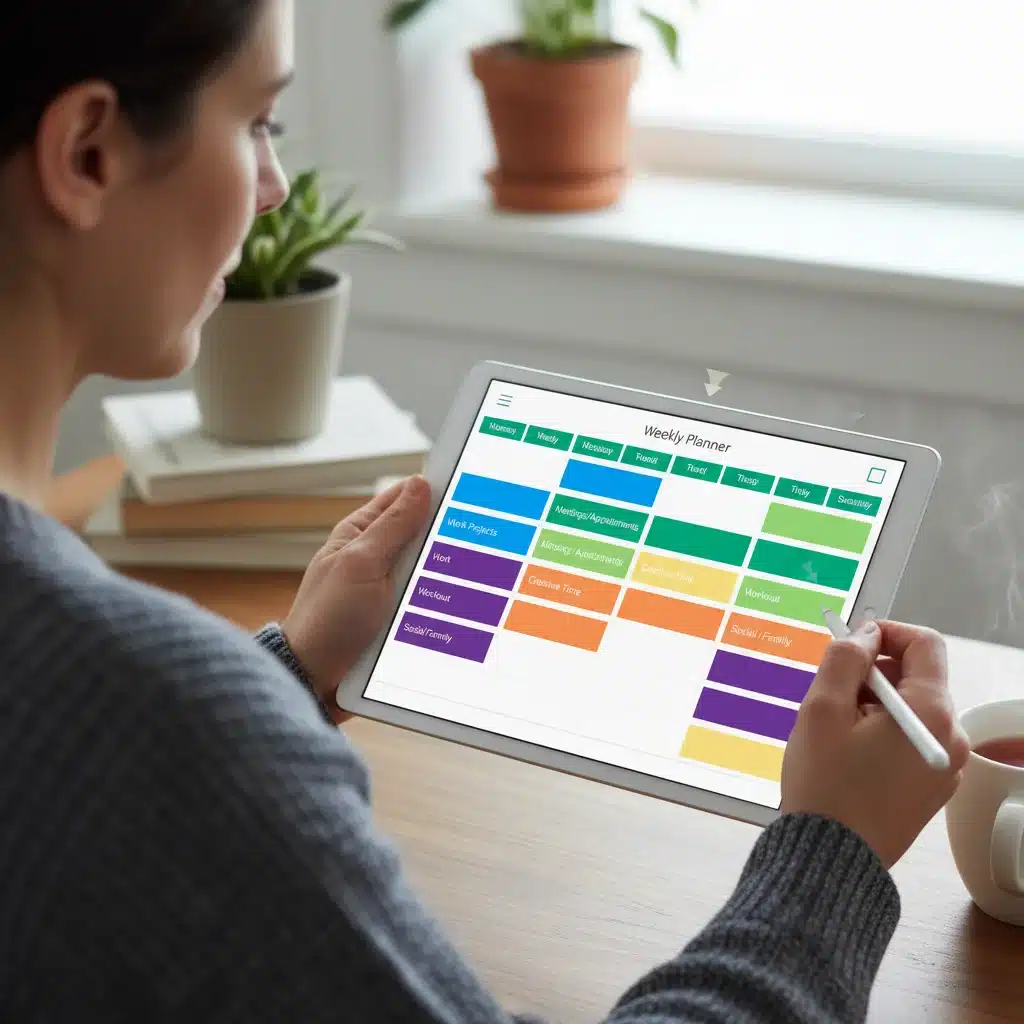
- Calendar Tools: Use Google Calendar, Outlook Calendar, Apple Calendar, or dedicated apps like Fantastical. Color-code different types of blocks (e.g., deep work, meetings, breaks, personal).
- Focus Apps: Tools like Forest, Freedom, or Cold Turkey can block distracting websites and apps during your deep work blocks.
- Task Managers: Integrate your time blocks with a task manager (e.g., Todoist, Asana, Trello) to pull specific tasks into your scheduled blocks.
- Noise-Canceling Headphones: An essential tool for creating a personal ‘focus bubble’ in a potentially noisy remote environment.
3. The Art of Saying ‘No’ and Managing Expectations
One of the hardest but most crucial skills for effective remote work time blocking is the ability to politely but firmly decline requests that don’t align with your blocked schedule or priorities. This applies to both internal team requests and external distractions.
- Internal: ‘I’d love to help with that, but I have a dedicated deep work block right now. Can we discuss it at 3 PM during my collaboration block?’
- External: Inform friends and family about your work hours and communicate your need for uninterrupted focus during specific times.
Setting clear expectations with stakeholders is vital for protecting your time blocks.
4. Incorporating Self-Care and Movement
Achieving 40+ hours of focused work isn’t just about work; it’s about sustainable productivity. Block time for physical activity, mindfulness, healthy meals, and genuine breaks away from your screen. Neglecting these aspects will inevitably lead to burnout and diminished focus.
Consider ‘walking meetings’ or short exercise breaks integrated into your schedule to combat the sedentary nature of remote work.
Common Pitfalls and How to Avoid Them
Even with the best intentions, several common issues can derail your remote work time blocking efforts:
- Over-scheduling: Trying to fill every minute leads to exhaustion and frustration when things inevitably don’t go according to plan. Remember buffer and flex blocks.
- Lack of Specificity: Vague blocks like ‘Work’ or ‘Project’ don’t provide enough direction. Be precise about the task you’ll be doing.
- Ignoring Interruptions: While you aim to minimize them, interruptions happen. Have a strategy for handling them (e.g., quickly note them down for your flex block, politely defer).
- Not Reviewing: Without regular review, your system won’t adapt and improve. The weekly review is non-negotiable.
- Giving Up Too Soon: It takes time to build a new habit. Expect some bumps in the road and be patient with yourself. Consistency, not perfection, is the goal.
- Failing to Communicate: If your team or family isn’t aware of your system, they can’t support it. Over-communicate your boundaries.
Measuring Success: Consistently Achieving 40+ Hours of Focused Work
How do you know if your advanced remote work time blocking strategy is working? It’s not just about filling your calendar; it’s about the quality and impact of that time.
- Track Deep Work Hours: Actively track how many hours you spend in genuine deep work each week. Aim for consistent increases.
- Task Completion Rate: Are you consistently completing the tasks you set out to do within your blocks?
- Reduced Stress: A well-implemented system should reduce feelings of overwhelm and stress, replacing them with a sense of control.
- Improved Work-Life Balance: Are you able to fully disconnect from work during your personal time?
- Quality of Output: Is the work you’re producing of higher quality due to increased focus?
Use your weekly review to assess these metrics and make data-driven adjustments.
Conclusion: Your Path to Remote Work Mastery
For the remote professional, time is not just money; it’s focus, impact, and well-being. Mastering advanced remote work time blocking is not merely a productivity hack; it’s a fundamental shift in how you approach your professional life. By intentionally structuring your days, protecting your focus, and continuously refining your system, you move from reacting to your schedule to proactively designing it. This empowers you to not only meet but consistently exceed your professional goals, achieving 40+ hours of deep, meaningful work each week, all while maintaining a healthier, more balanced life. Embrace these advanced strategies, be patient with the process, and watch your remote productivity soar.