2026 Guide: US Residency for Digital Nomads – Avoid Pitfalls & Ensure Compliance

The allure of the United States, with its vibrant cities, diverse landscapes, and robust economy, continues to attract professionals from around the globe. For the burgeoning community of digital nomads, the prospect of establishing residency in the US while maintaining a remote work lifestyle is particularly appealing. However, navigating the intricate web of US immigration, tax, and legal requirements can be a daunting task. This comprehensive guide, tailored for 2026, aims to demystify the process of establishing digital nomad US residency, highlighting common pitfalls and offering strategies for ensuring compliance.
As the world of work evolves, so do the regulations governing international mobility. The information presented here is current as of 2026 and is designed to provide a foundational understanding. It is crucial to remember that immigration and tax laws are complex and subject to change, making professional legal and tax advice indispensable for individual circumstances.
Understanding the Digital Nomad Landscape in the US
The term ‘digital nomad’ generally refers to individuals who leverage technology to work remotely, often while traveling or living in various locations. While many countries have introduced specific digital nomad visas, the United States currently does not have a dedicated visa category for this lifestyle. This absence necessitates a careful examination of existing visa options that may accommodate remote workers seeking to establish a temporary or long-term presence in the US.
The Evolving Definition of ‘Residency’ for Digital Nomads
For digital nomads, ‘residency’ can have multiple meanings, often differing between immigration and tax contexts. From an immigration perspective, it refers to your legal status and right to reside in the US. From a tax perspective, it concerns where you are deemed a resident for tax purposes, which dictates your tax obligations. Understanding this distinction is paramount to avoiding future complications.
Visa Pathways for Digital Nomads Seeking US Residency
Since a specific digital nomad visa for the US does not exist, prospective digital nomads must explore existing non-immigrant and immigrant visa categories. The suitability of each option depends heavily on your nationality, skills, intent, and the nature of your remote work.
Non-Immigrant Visas: Temporary Solutions
Non-immigrant visas are for individuals who intend to reside in the US temporarily. They do not typically lead to permanent residency. For digital nomads, the challenge lies in finding a non-immigrant visa that permits remote work for a foreign employer or self-employment without violating the terms of their stay.
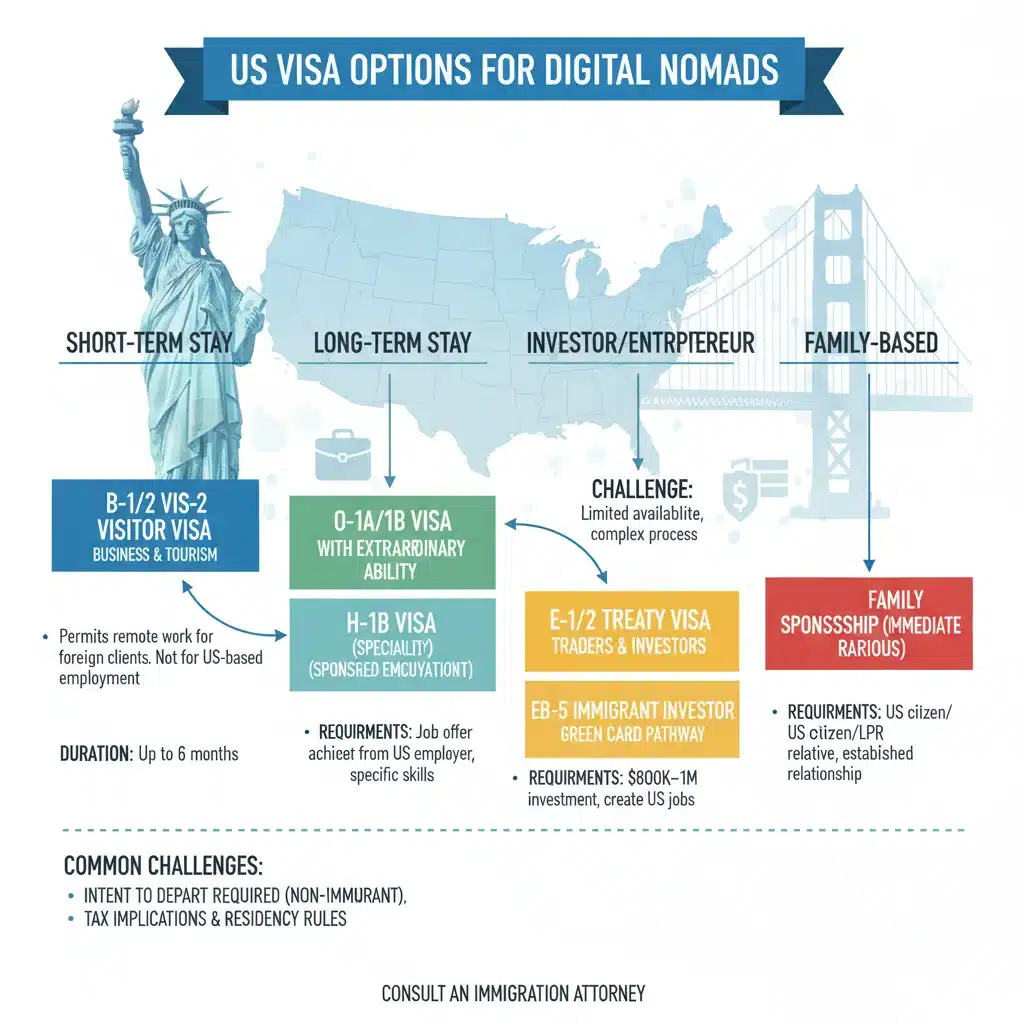
- B-1/B-2 Visitor Visas (Business/Tourism): While tempting, using a B-1 (business visitor) or B-2 (tourism) visa for extensive remote work in the US is highly risky and generally not permissible. A B-1 visa allows for activities like attending conferences, negotiating contracts, or consulting with business associates, but not for performing productive labor for which you are paid in the US or even for a foreign employer if your primary purpose of entry is to work remotely. A B-2 visa is strictly for tourism. Overstaying or engaging in unauthorized work can lead to serious immigration consequences, including future visa denials and bans from re-entry.
- E-2 Treaty Investor Visa: This visa is available to nationals of countries with which the US maintains treaties of commerce and navigation. It requires a substantial investment in a US enterprise. While not a direct digital nomad visa, an E-2 could be an option if a digital nomad establishes a US-based business that meets the investment criteria and generates jobs.
- L-1 Intracompany Transferee Visa: If you work for a multinational company with offices in the US, an L-1 visa could be an option. This visa allows eligible employees to transfer to the US branch. While you’d be working for the US entity, your role might involve remote work, depending on the company’s structure.
- O-1 Visa for Individuals with Extraordinary Ability: For highly accomplished digital nomads in fields like science, arts, education, business, or athletics, the O-1 visa is a possibility. This requires demonstrating extraordinary ability through sustained national or international acclaim.
- H-1B Specialty Occupation Visa: The H-1B visa is for individuals coming to the US to perform services in a specialty occupation. This typically requires a bachelor’s degree or higher in a specific field. The employer must sponsor the petition. While competitive and subject to an annual cap, it’s a common pathway for skilled professionals, including those who may work remotely for a US employer.
Immigrant Visas: Pathways to Permanent Residency (Green Card)
For digital nomads seeking a more permanent solution, immigrant visas lead to lawful permanent residency (a Green Card). These pathways are generally more complex and time-consuming.
- Employment-Based Green Cards (EB-1, EB-2, EB-3): These categories are for workers with extraordinary abilities (EB-1), professionals with advanced degrees or exceptional ability (EB-2), and skilled workers, professionals, or other workers (EB-3). Many digital nomads, especially those with specialized skills, might qualify for these if they have a US employer willing to sponsor them or meet the stringent self-petition requirements.
- Family-Based Green Cards: If you have a close family member who is a US citizen or lawful permanent resident, they may be able to petition for you. This is often the most straightforward path to permanent residency for those with qualifying family ties.
- Diversity Visa Lottery (Green Card Lottery): The Diversity Visa (DV) program makes up to 50,000 immigrant visas available annually, drawn from random selection among all entries from countries with historically low rates of immigration to the United States. While purely a lottery, it offers a chance for individuals from eligible countries.
Key Considerations for Digital Nomads in the US
Tax Implications: Navigating the US Tax System
One of the most critical and often misunderstood aspects of establishing digital nomad US residency is tax liability. The US tax system is complex, and your residency status for immigration purposes might differ from your residency status for tax purposes. The US taxes its citizens and residents on their worldwide income, regardless of where they live or earn it.
Determining Tax Residency
For digital nomads, tax residency is typically determined by the ‘substantial presence test’ or by holding a Green Card. If you are not a US citizen or Green Card holder, you are generally considered a US resident for tax purposes if you meet the substantial presence test for the calendar year. You meet this test if you are physically present in the US on at least:
- 31 days during the current year, and
- 183 days during the 3-year period that includes the current year and the 2 years immediately before that, counting:
- All the days you were present in the current year,
- 1/3 of the days you were present in the first preceding year, and
- 1/6 of the days you were present in the second preceding year.
Exempt individuals (e.g., certain foreign government-related individuals, teachers, trainees, students, professional athletes) are not counted for the substantial presence test.
Worldwide Income Taxation
If you are deemed a US tax resident, you must report all your worldwide income to the IRS, even if it’s earned from a foreign client or employer while you are physically present in the US. This can include income from remote work, investments, and other sources.
Foreign Earned Income Exclusion (FEIE)
The FEIE allows qualifying US citizens and resident aliens to exclude a certain amount of foreign earned income from US tax. However, to qualify, you must meet either the ‘bona fide residence test’ or the ‘physical presence test’ in a foreign country. This typically means you must live and work outside the US for a significant period. For digital nomads primarily residing in the US, the FEIE is usually not applicable to income earned while physically in the US.
State Taxes
In addition to federal taxes, many states also levy income taxes. Your state tax residency is determined by each state’s specific rules, which often involve factors like physical presence, domicile, and intent. It’s possible to be a tax resident of one state even if you spend significant time elsewhere, or to be a tax resident of no state if you don’t establish domicile.
Tax Treaties
The US has tax treaties with many countries designed to prevent double taxation. These treaties can sometimes reduce or eliminate US tax on certain types of income for residents of treaty countries. However, their application is highly specific and depends on your individual circumstances and the terms of the relevant treaty.

Healthcare and Insurance
The US healthcare system is predominantly private and can be very expensive. Digital nomads establishing residency must secure adequate health insurance. Options include:
- Travel Insurance: While suitable for short visits, travel insurance typically doesn’t cover long-term residency and may have limitations on coverage within the US.
- Private Health Insurance: Many companies offer plans through the Affordable Care Act (ACA) marketplaces or directly. Eligibility and subsidies depend on income and residency status.
- International Health Insurance: Some providers specialize in international health insurance plans that can cover you in multiple countries, including the US.
Banking and Financial Services
Opening a US bank account is essential for managing finances. This usually requires a valid US address and a Social Security Number (SSN) or Individual Taxpayer Identification Number (ITIN). Understanding international money transfers, foreign exchange rates, and reporting foreign bank accounts (FBAR) to the IRS are also critical.
Avoiding Common Pitfalls and Ensuring Compliance
1. Misrepresenting Your Intent to Immigration Officials
One of the most significant pitfalls is entering the US on a visa that does not permit your intended activities. For example, using a B-2 tourist visa to perform extensive remote work, even for a foreign employer, can be considered a violation of your visa terms. Always be truthful about your purpose of travel and adhere strictly to your visa’s conditions.
2. Overstaying Your Visa
Overstaying a visa, even by a single day, can have severe consequences, including accumulating unlawful presence, which can lead to bars from re-entering the US for several years. Always monitor your authorized period of stay and depart on time or seek an extension if eligible.
3. Neglecting Tax Obligations
The IRS has a broad reach. Failure to file tax returns or pay taxes as a US tax resident can result in significant penalties, interest, and even criminal charges. If you believe you might be a US tax resident, consult with a qualified tax professional immediately.
4. Lack of Proper Documentation
Maintain meticulous records of your immigration documents, visa applications, entry and exit stamps, tax filings, and financial transactions. Good record-keeping is invaluable in case of audits or immigration inquiries.
5. Not Understanding State-Specific Laws
Beyond federal laws, each US state has its own regulations regarding residency, driving licenses, vehicle registration, and business permits. If you plan to establish a fixed abode in a particular state, research its specific requirements.
6. Unauthorized Employment
Engaging in unauthorized employment is a serious immigration violation. This includes performing work for which you are not authorized, even if it’s remote work for a foreign employer while on a non-work visa. Ensure your visa category explicitly permits your work activities.
Strategies for Successful Digital Nomad US Residency
1. Seek Professional Legal and Tax Advice
This cannot be stressed enough. Given the complexity of US immigration and tax laws, consulting with an experienced immigration attorney and a tax professional specializing in international taxation is crucial. They can assess your unique situation, recommend the most appropriate visa pathways, and help you navigate compliance.
2. Plan Ahead
Immigration processes can be lengthy. Start your research and application processes well in advance of your desired move date. Gathering necessary documents, preparing applications, and attending interviews can take months, if not longer.
3. Understand Your Visa’s Limitations
Before applying for any visa, thoroughly understand what it permits and what it prohibits. Do not assume that because you work remotely for a foreign company, it falls outside the scope of US immigration regulations. The location of your physical presence while working is often the determining factor.
4. Establish Clear Tax Residency
If you intend to become a US tax resident, embrace it. Understand your obligations, file all necessary federal and state tax returns, and keep accurate records of your income and expenses. If you are uncertain about your tax residency status, seek expert advice.
5. Consider Establishing a US Business
For some digital nomads, especially those with entrepreneurial ambitions, establishing a US-based business might open up more visa options (e.g., E-2, L-1, or certain employment-based Green Cards if you can sponsor yourself or others). This requires a significant commitment and understanding of US business laws.
6. Build a Support Network
Connect with other digital nomads and expatriates in the US. Online forums, local meetups, and professional networking groups can provide valuable insights, support, and practical advice on living and working in the US.
The Future of Digital Nomad Visas in the US (2026 Outlook)
As of 2026, a dedicated US digital nomad visa remains elusive. However, the global trend towards remote work and the increasing recognition of the economic contributions of digital nomads suggest that this landscape could evolve. Advocacy groups and economic development agencies continue to push for more accommodating visa categories. While no immediate changes are guaranteed, staying informed about legislative developments is advisable.
Currently, the US stance prioritizes skilled workers and those with family ties. Therefore, for the foreseeable future, digital nomads will likely need to continue fitting into existing visa categories or exploring avenues that lead to permanent residency through traditional means.
Conclusion
Establishing digital nomad US residency in 2026 is a complex endeavor that requires meticulous planning, a thorough understanding of immigration and tax laws, and a commitment to compliance. While the absence of a specific digital nomad visa presents challenges, various existing pathways can be leveraged with the right strategy and professional guidance.
By carefully considering visa options, understanding your tax obligations, securing adequate healthcare, and avoiding common pitfalls, digital nomads can successfully navigate the US system. Remember, proactive planning and expert advice are your best allies in making your dream of US residency a reality while maintaining your remote work lifestyle.
The journey to becoming a US-based digital nomad is not without its hurdles, but with diligence and adherence to legal requirements, it is an achievable goal. Stay informed, stay compliant, and embrace the opportunities that await you in the United States.