2026 Guide: Establishing U.S. Domicile as a Digital Nomad
Establishing U.S. domicile as a digital nomad in 2026 requires strategic planning to maintain legal and financial ties, ensuring continued access to residency benefits and compliance with complex regulations while living a location-independent lifestyle.
For many, the dream of a digital nomad lifestyle involves exploring the world, but for U.S. citizens, it also brings the unique challenge of maintaining a connection to home. This 2026 Guide to Establishing U.S. Domicile as a Digital Nomad: Insider Strategies to Maintain Residency Benefits provides crucial insights into navigating the legal and practicalities of retaining your U.S. ties while embracing global mobility. Understanding domicile is not just about taxes; it’s about preserving access to healthcare, voting rights, and often, a sense of belonging.
understanding U.S. Domicile for the Global Citizen
Defining U.S. domicile is often more complex for digital nomads than for traditional residents. It’s not merely about physical presence but rather about intent to return and reside indefinitely. This legal concept impacts everything from your tax obligations to your ability to vote in federal elections, making it a cornerstone of your remote lifestyle planning.
Many digital nomads mistakenly believe that simply spending less than 183 days in the U.S. automatically severs their domicile. However, domicile is a much deeper legal concept, focusing on your long-term intent and actions. It’s about where you consider your true home to be, even if you’re rarely there.
the difference between residency and domicile
While often used interchangeably, residency and domicile have distinct legal meanings. Residency generally refers to where you physically live for a period, often for tax purposes. Domicile, on the other hand, signifies your permanent home, the place to which you intend to return whenever you are absent. For digital nomads, this distinction is paramount.
- Residency: Often determined by physical presence and can change frequently based on travel. It dictates where you pay state income taxes for a given year.
- Domicile: A more fixed concept, requiring a clear intent to abandon old domicile and establish a new one. It influences voting rights, estate laws, and sometimes even tuition rates.
- Impact for Nomads: A digital nomad might be a resident of multiple countries for tax purposes in a single year but can only have one U.S. domicile.
why maintaining U.S. domicile matters
Maintaining a clear U.S. domicile offers several advantages for digital nomads. It simplifies tax filings, ensures continuity for legal matters, and provides a stable base for administrative tasks. Without a defined domicile, you risk legal ambiguities that can complicate your international lifestyle.
Understanding these foundational concepts is the first step in building a robust strategy for your digital nomad journey. It sets the stage for making informed decisions about your legal and financial future, ensuring you remain compliant and connected to the U.S. while enjoying your freedom to roam.
strategic state selection for digital nomads
Choosing the right U.S. state for your domicile is a critical decision for digital nomads, impacting everything from taxes to vehicle registration. States like South Dakota, Florida, and Texas have become popular choices due to their favorable tax laws and easy-to-establish residency requirements for those with no fixed abode.
This strategic selection can significantly reduce your administrative burden and optimize your financial situation. It’s not just about avoiding state income tax, but also considering aspects like vehicle insurance, voter registration, and ease of establishing proof of intent to return.
states with no state income tax
Several states do not levy a state income tax, making them attractive to digital nomads. These states allow you to keep more of your earnings, which is particularly beneficial when your income sources are global. The financial savings can be substantial over time.
- Florida: Known for its warm climate and no state income tax. Establishing domicile can involve obtaining a Florida driver’s license, registering to vote, and opening a bank account.
- Texas: Offers no state income tax and a relatively low cost of living in many areas. Similar steps to Florida apply for proving domicile.
- South Dakota: A particularly popular choice for RVers and full-time travelers due to its lenient residency requirements and mail forwarding services.
factors beyond income tax
While state income tax is a significant consideration, it shouldn’t be the only one. Other factors can influence your choice of domicile state, affecting your overall ease of living as a digital nomad. These include vehicle registration, insurance costs, and even jury duty requirements.
For example, some states have more forgiving laws regarding vehicle inspections or easier processes for renewing driver’s licenses remotely. Researching these nuances can save you considerable hassle down the line. It’s a holistic decision, not just a financial one.
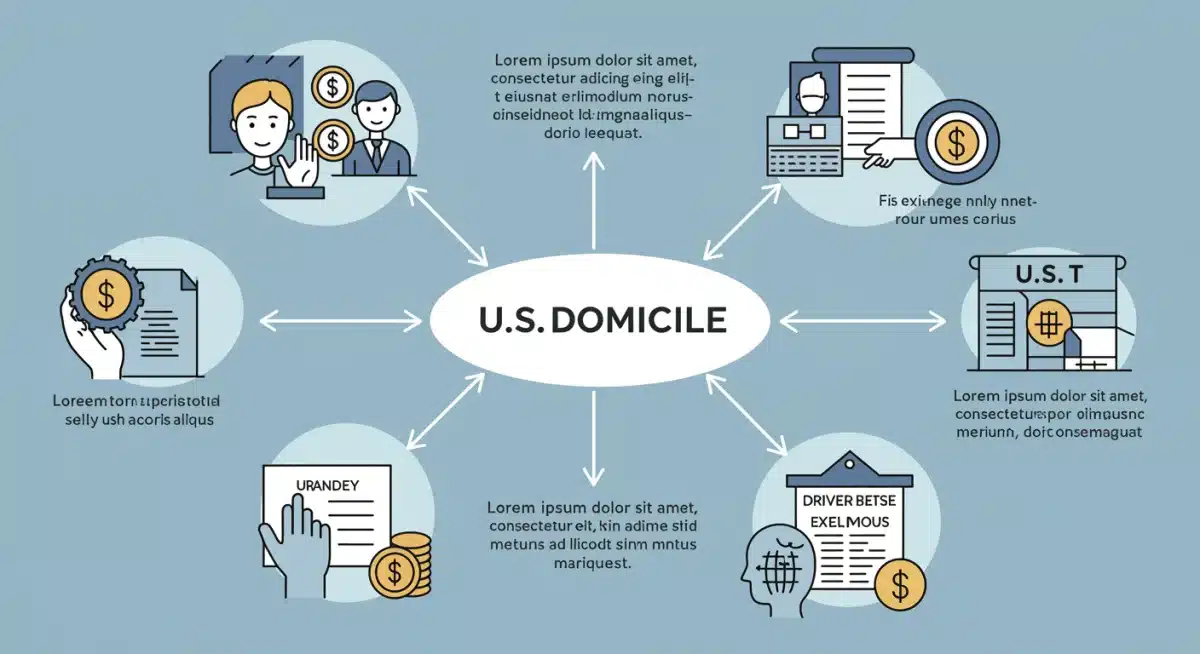
Ultimately, the best state for your domicile depends on your individual circumstances and priorities. A thorough review of each state’s laws, coupled with your personal travel and financial plans, will guide you to the most suitable option. This initial planning pays dividends in the long run.
establishing intent: physical and documentary evidence
Establishing U.S. domicile requires more than just declaring your intent; it demands tangible proof. Both physical and documentary evidence are crucial to demonstrate your genuine connection to a specific state, even when you’re thousands of miles away. This evidence forms the backbone of your domicile claim.
Authorities look for a pattern of behavior and official documentation that consistently points to your chosen state as your permanent home. Inconsistent actions can undermine your claim, leading to potential legal and tax complications.
key documentary evidence
Official documents are perhaps the strongest forms of evidence for establishing domicile. These papers link you directly to your chosen state and are often the first things legal and tax authorities will request. Maintaining these meticulously is paramount for any digital nomad.
- Driver’s License/State ID: Obtain a driver’s license or state identification card from your chosen domicile state. This is often considered primary evidence of intent.
- Voter Registration: Register to vote in your domicile state and, if possible, vote in elections. This clearly indicates your civic participation and ties to the state.
- Vehicle Registration: If you own a vehicle, register it in your domicile state. This includes boats, RVs, and any other motorized assets.
- Bank Accounts: Establish bank accounts with a physical address in your domicile state. This strengthens your financial ties to the location.
- Mail Forwarding Service: Utilize a reputable mail forwarding service with an address in your chosen state. This provides a consistent physical address for official correspondence.
- Property Ownership/Rental Agreement: While not strictly necessary, owning property or having a long-term rental agreement in the state can significantly bolster your claim.
physical actions demonstrating intent
Beyond paperwork, your physical actions also play a significant role in demonstrating your intent to maintain domicile. These actions, though seemingly small, collectively paint a picture of your long-term connection to your chosen state. Consistency is key here.
For example, returning to your domicile state for medical appointments, family visits, or even for specific annual events can reinforce your claim. The more you can demonstrate a regular pattern of returning, the stronger your case becomes. It’s about building a narrative of connection.
By diligently collecting and maintaining both documentary and physical evidence, digital nomads can confidently assert their U.S. domicile. This proactive approach minimizes risks and provides peace of mind, allowing you to focus on your global adventures.
managing taxes and financial obligations
Navigating U.S. tax obligations as a digital nomad with an established domicile requires careful planning. While you might be living abroad, your U.S. citizenship and domicile mean you’re still subject to federal taxes, and potentially state taxes, depending on your income sources and physical presence. This section explores strategies to manage these complexities efficiently.
Understanding the nuances of international tax treaties, the Foreign Earned Income Exclusion (FEIE), and state-specific tax rules is crucial. Missteps can lead to significant penalties, making proactive financial management indispensable for long-term remote work success.
federal tax considerations: feie and tax treaties
The Foreign Earned Income Exclusion (FEIE) is a cornerstone for many U.S. digital nomads, allowing them to exclude a significant portion of their foreign earned income from U.S. federal taxes. However, qualifying for FEIE requires meeting either the Physical Presence Test or the Bona Fide Residence Test.
- Physical Presence Test: Requires you to be physically present in a foreign country or countries for at least 330 full days during any period of 12 consecutive months.
- Bona Fide Residence Test: Requires you to be a bona fide resident of a foreign country for an uninterrupted period that includes an entire tax year. This is a more subjective test based on your intent and establishment of roots abroad.
- Tax Treaties: The U.S. has tax treaties with many countries, which can help prevent double taxation. Understanding these treaties, especially the ‘tie-breaker’ rules for residency, is vital.
state tax implications and domicile
Even with federal tax exclusions, state tax obligations can still apply. Your chosen domicile state’s tax laws will dictate your state income tax liability, if any. This is where the initial strategic state selection truly pays off, particularly if you’ve chosen a state with no income tax.
However, simply having domicile in a no-income-tax state doesn’t automatically exempt you from all state taxes. If you spend significant time in another state with income tax, you might inadvertently establish residency there for tax purposes, creating a new set of obligations. Careful tracking of physical presence is essential.
Proactive engagement with a tax professional specializing in expatriate and digital nomad taxation is highly recommended. Their expertise can ensure compliance, maximize legitimate deductions, and navigate the intricate web of international and state tax laws, providing peace of mind for your global lifestyle.
healthcare and insurance solutions for nomads
Healthcare is a paramount concern for digital nomads, especially when maintaining U.S. domicile. While you might be abroad, having a plan for medical emergencies and routine care, both internationally and during visits to the U.S., is non-negotiable. This involves exploring various insurance options and understanding their limitations.
The complexities of U.S. healthcare, combined with the global nature of digital nomadism, necessitate a well-thought-out insurance strategy. Relying solely on travel insurance for long-term needs is often insufficient and can lead to significant out-of-pocket expenses.
international health insurance options
For long-term digital nomads, international health insurance is often the most comprehensive solution. These plans are designed for individuals living abroad for extended periods and typically offer broader coverage than standard travel insurance policies. They provide access to medical care in various countries, including emergency services and sometimes even routine check-ups.
- Global Coverage: Many plans offer worldwide coverage, with options to include or exclude the U.S., which can significantly impact premiums.
- Emergency Evacuation: Critical for nomads, these policies often include coverage for emergency medical evacuation to a facility that can provide appropriate care.
- Repatriation: Covers the cost of returning your remains to your home country in the event of death abroad.
maintaining U.S. healthcare ties
Even with international insurance, many digital nomads wish to maintain some form of U.S. healthcare coverage, particularly for when they return for visits or in case of a need for specialized care. This is where maintaining U.S. domicile becomes particularly relevant.
Options such as catastrophic plans, short-term health insurance for U.S. visits, or even maintaining a state-specific plan (if your domicile state allows for remote enrollment and usage) should be explored. The Affordable Care Act (ACA) marketplace might also offer options, though qualifying for subsidies while living abroad can be complex. Consulting with an insurance broker specializing in expatriate health plans can help tailor a solution that fits your unique needs and budget, ensuring you’re covered no matter where your travels take you.
voting and civic engagement from afar
One of the key benefits of maintaining U.S. domicile as a digital nomad is the ability to retain your voting rights. Participating in U.S. elections, even from abroad, is a fundamental civic duty and a way to stay connected to your home country. Various mechanisms exist to facilitate remote voting, ensuring your voice is heard.
Beyond voting, there are other ways to engage civically and maintain ties to your domicile state. This engagement reinforces your intent to return and strengthens your overall claim to U.S. domicile, beyond just official documents.
registering and voting absentee
The Uniformed and Overseas Citizens Absentee Voting Act (UOCAVA) protects the voting rights of U.S. citizens living abroad, including digital nomads. This act simplifies the process of registering to vote and casting an absentee ballot from any foreign country.
- Federal Post Card Application (FPCA): This form allows you to register to vote, request an absentee ballot, and update your contact information simultaneously. It’s the primary tool for overseas voters.
- State-Specific Rules: While UOCAVA provides a federal framework, each state has its own deadlines and procedures for absentee voting. It’s crucial to check your domicile state’s election website for specific instructions.
- Electronic Ballot Delivery: Many states now offer electronic delivery of ballots, making the process faster and more convenient for digital nomads.
staying connected and engaged
Beyond the ballot box, digital nomads can stay engaged with their domicile state through various means. This continuous connection further solidifies your intent to return and your investment in your home community. This is about maintaining a sense of belonging.
Subscribing to local news, participating in online community forums, or even maintaining memberships in state-based organizations can keep you informed and involved. These actions, while not legal requirements, contribute to a stronger narrative of domicile, demonstrating a genuine desire to remain a part of your chosen U.S. community, even from a distance.
future-proofing your digital nomad domicile strategy
As the landscape of remote work evolves, so too do the legal and practical considerations for digital nomads maintaining U.S. domicile. Future-proofing your strategy means staying informed about legislative changes, technological advancements, and evolving best practices. This proactive approach ensures your domicile remains secure and beneficial in the long term.
The year 2026 brings new challenges and opportunities. Laws can shift, and the interpretation of domicile rules may adapt to the increasing prevalence of global remote work. Continuous vigilance and adaptability are key to sustained success.
monitoring legislative changes
Both federal and state governments may introduce new legislation that impacts digital nomads. Tax laws, residency requirements, and even voting regulations can change, directly affecting your domicile strategy. Subscribing to legal and tax updates from reputable sources is essential.
For instance, there might be new incentives for remote workers to establish domicile in certain states, or conversely, stricter rules regarding proof of intent. Staying ahead of these changes allows you to adjust your strategy proactively, avoiding potential non-compliance or missed opportunities. This continuous learning is a vital part of the digital nomad lifestyle.
leveraging technology and expert advice
Technology continues to offer new tools for digital nomads to manage their administrative tasks and maintain their domicile. From advanced mail forwarding services to secure online banking and digital identity verification, these tools streamline processes and enhance security.
However, technology alone isn’t enough. Regular consultation with legal and tax professionals specializing in global mobility is invaluable. Their expertise can help interpret complex regulations, optimize your financial situation, and ensure your domicile strategy remains robust against future changes. Investing in expert advice is an investment in your peace of mind and the longevity of your digital nomad journey.
| Key Domicile Strategy | Brief Description |
|---|---|
| Strategic State Choice | Select a U.S. state (e.g., SD, FL, TX) with favorable tax laws and easy domicile establishment. |
| Proof of Intent | Gather documentary evidence like driver’s license, voter registration, and mail forwarding. |
| Tax Optimization | Utilize FEIE and understand state tax implications to minimize tax burden. |
| Healthcare Planning | Secure international health insurance and consider U.S. coverage for visits. |
Frequently Asked Questions About U.S. Domicile
Residency refers to where you physically live, often for tax purposes, and can change frequently. Domicile signifies your permanent home, the place you intend to return to, and is a more fixed legal concept influencing voting and estate laws.
States like South Dakota, Florida, and Texas are popular due to their lack of state income tax and relatively straightforward processes for establishing domicile, which often includes mail forwarding services and easy vehicle registration.
Proof includes a U.S. driver’s license or state ID, voter registration, vehicle registration, U.S. bank accounts, use of a mail forwarding service, and demonstrating intent to return through physical actions and maintaining ties.
FEIE allows qualifying digital nomads to exclude a portion of their foreign earned income from U.S. federal taxes. Qualification depends on meeting either the Physical Presence Test (330 days abroad) or the Bona Fide Residence Test.
Yes, U.S. citizens abroad can vote via absentee ballot under the Uniformed and Overseas Citizens Absentee Voting Act (UOCAVA). Registering through the Federal Post Card Application (FPCA) is the primary method to do so.
Conclusion
Establishing and maintaining U.S. domicile as a digital nomad in 2026 is a nuanced but achievable goal. By strategically selecting a domicile state, diligently gathering evidence of intent, carefully managing tax and financial obligations, securing appropriate healthcare, and actively engaging in civic duties, digital nomads can enjoy the freedom of global travel without severing their vital ties to the United States. Proactive planning and seeking expert advice are indispensable for navigating these complexities, ensuring a compliant and sustainable remote lifestyle for years to come.