Eisenhower Matrix 2026: 30% Productivity Gains Beyond To-Do Lists

Anúncios
The Eisenhower Matrix is an essential framework for task prioritization, enabling individuals and teams to move past simple to-do lists and achieve substantial productivity gains, particularly crucial for remote work efficiency by 2026.
In the rapidly evolving landscape of remote work, conventional to-do lists often fall short, struggling to keep pace with the demands of a dynamic professional environment. To truly thrive and achieve significant efficiency, especially aiming for a 30% productivity increase by 2026, professionals need a more sophisticated approach. This is where the Eisenhower Matrix productivity framework emerges as an indispensable tool, offering a strategic method to prioritize tasks beyond mere completion and focus on what truly matters.
Anúncios
Understanding the Eisenhower Matrix: A Foundation for Strategic Prioritization
The Eisenhower Matrix, also known as the Urgent-Important Matrix, is a powerful time management tool that helps individuals categorize tasks based on their urgency and importance. This method, attributed to former U.S. President Dwight D. Eisenhower, provides a clear visual framework for making informed decisions about task execution, delegation, and elimination.
Its core principle lies in distinguishing between what is urgent and what is important, a nuance often missed when simply listing tasks. By understanding this distinction, professionals can allocate their time and energy more effectively, ensuring that high-value activities receive the attention they deserve, while less critical tasks are managed appropriately or simply removed from the agenda.
Anúncios
The Four Quadrants Explained
The matrix divides tasks into four distinct quadrants, each dictating a specific course of action. This structured approach prevents reactive work habits and encourages proactive planning, critical for sustained productivity gains in a remote setting.
- Quadrant 1: Urgent & Important (Do First): These are crises, deadlines, and problems that require immediate attention. Focusing too much here indicates poor planning, but these tasks are unavoidable and must be tackled promptly.
- Quadrant 2: Important, Not Urgent (Schedule): This is the quadrant for long-term planning, relationship building, and proactive work. Dedicating sufficient time here prevents tasks from becoming urgent crises, leading to significant productivity boosts.
- Quadrant 3: Urgent, Not Important (Delegate): These tasks are often interruptions or demands from others that feel pressing but do not contribute directly to your core goals. They should be delegated or handled quickly to minimize disruption.
- Quadrant 4: Not Urgent & Not Important (Eliminate): These are time-wasters and distractions that should be avoided. Identifying and eliminating these activities frees up valuable time for more impactful work.
Mastering the Eisenhower Matrix involves more than just categorizing; it requires a conscious shift in mindset, moving from simply doing to strategically prioritizing. This fundamental understanding is the first step towards leveraging this tool for substantial productivity improvements in the coming years.
Moving Beyond Traditional To-Do Lists: Why the Matrix Excels
Traditional to-do lists, while seemingly helpful, often create a false sense of accomplishment. They treat all tasks equally, leading to an overwhelming feeling of having much to do without a clear sense of priority or impact. In contrast, the Eisenhower Matrix provides a robust framework that transcends the limitations of simple task enumeration.
The inherent flaw in a linear to-do list is its inability to differentiate between a minor administrative task and a critical project milestone. This lack of distinction can lead to spending valuable time on low-impact activities, while truly important work languishes, eventually becoming urgent and stressful. The Matrix, however, forces a crucial evaluation of each task’s true value and immediate necessity.
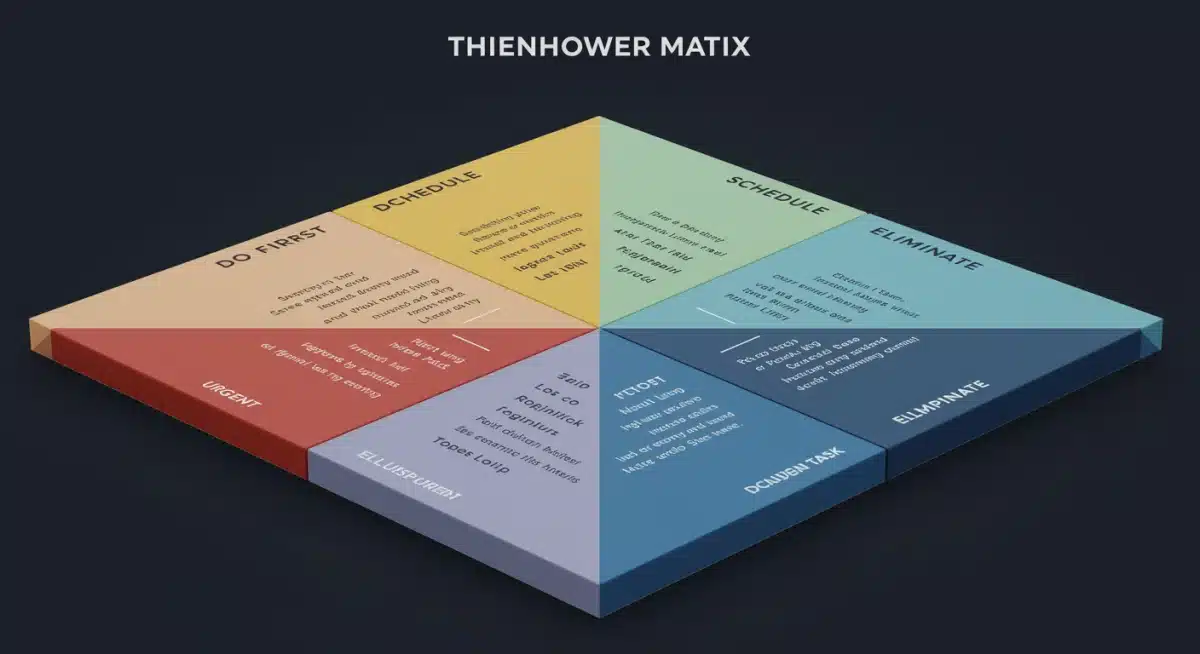
By categorizing tasks into its four quadrants, the Eisenhower Matrix compels users to assess both urgency and importance, offering a strategic lens through which to view their workload. This process naturally highlights what truly drives progress versus what merely fills the day. For remote professionals, where self-direction is paramount, this distinction is invaluable.
Enhanced Decision-Making and Focus
The clarity provided by the Matrix directly translates into improved decision-making. Instead of reacting to every incoming request, individuals can proactively decide where their efforts are best spent. This fosters a more focused approach, reducing distractions and enhancing deep work, a cornerstone of high productivity.
- Reduced Overwhelm: By visually separating tasks, the matrix makes an overwhelming workload feel more manageable and actionable.
- Strategic Alignment: It encourages alignment of daily tasks with long-term goals, ensuring efforts contribute to broader objectives.
- Proactive Planning: Emphasizing Quadrant 2 activities shifts focus from reactive problem-solving to proactive prevention and growth.
Ultimately, the Eisenhower Matrix transforms task management from a simple listing exercise into a strategic planning endeavor. This shift is fundamental for anyone aiming to significantly boost their productivity and achieve their professional goals in the competitive landscape of 2026.
Implementing the Matrix in a Remote Work Environment
Implementing the Eisenhower Matrix effectively within a remote work setup requires deliberate practice and adaptation. The absence of traditional office structures means individuals must be even more disciplined in their self-management. The Matrix provides the perfect structure for this, helping remote workers maintain focus and prioritize autonomously.
One of the primary challenges in remote work is the blurred line between personal and professional life, often leading to distractions and a lack of clear boundaries. The Matrix helps delineate these boundaries by providing a clear framework for what needs attention and when. This structure is essential for preventing burnout and maintaining a healthy work-life balance.
Tools and Techniques for Remote Application
Leveraging digital tools can significantly enhance the application of the Eisenhower Matrix in a remote context. Project management software, online whiteboards, and even simple digital note-taking apps can be configured to represent the four quadrants, allowing for dynamic task categorization and tracking.
- Digital Whiteboards: Tools like Miro or Mural can be used to create virtual Eisenhower Matrices, allowing for collaborative task sorting with remote teams.
- Project Management Software: Platforms such as Asana, Trello, or Monday.com can be customized with tags or columns corresponding to each quadrant.
- Time Blocking: Combine the Matrix with time blocking techniques. Once tasks are categorized, block out specific times in your calendar for Quadrant 1 and 2 activities.
Regular review of your Matrix is crucial for remote success. At the beginning of each day or week, reassess your tasks, shifting them between quadrants as priorities evolve. This consistent self-check ensures that your efforts remain aligned with your most important goals, driving continuous improvement in your remote work productivity.
Measuring Productivity Gains: Tracking Your Progress by 2026
To truly understand the impact of the Eisenhower Matrix and achieve a targeted 30% productivity gain by 2026, it’s essential to establish clear metrics and consistently track progress. Without measurable outcomes, even the most effective prioritization strategy can feel anecdotal. This section focuses on how to quantify the benefits and ensure continuous improvement.
The goal isn’t just to feel busy but to be demonstrably more effective. This involves moving beyond vague notions of ‘getting more done’ to concrete data points that illustrate efficiency, impact, and time utilization. Remote work offers unique opportunities for data collection, which, when analyzed through the lens of the Eisenhower Matrix, can reveal powerful insights.
Key Performance Indicators (KPIs) for Matrix Success
Identifying the right KPIs is crucial. These should align with your individual or team goals and reflect the nature of your work. For example, if your role involves project delivery, tracking completion rates of Quadrant 2 tasks would be highly relevant. For creative roles, perhaps the number of high-impact ideas generated or major projects initiated.
- Quadrant 2 Completion Rate: Track the percentage of important, non-urgent tasks completed within their scheduled timeframe. A high rate indicates effective proactive planning.
- Time Spent per Quadrant: Monitor how much time you allocate to each quadrant. A healthy balance should show significant time in Quadrant 2, minimal in Quadrant 1, and reduced in Quadrants 3 and 4.
- Impact Metrics: For each major task completed, assess its actual impact on your goals or the organization. This qualitative measure helps validate the importance assigned to tasks.
Regularly reviewing these metrics, perhaps weekly or bi-weekly, allows for adjustments to your Matrix application. If too many tasks are consistently falling into Quadrant 1, it signals a need for more proactive planning. If Quadrant 4 activities are still consuming too much time, further elimination strategies are required. This data-driven approach is key to achieving and sustaining significant productivity improvements.
Overcoming Common Pitfalls and Sustaining Momentum
While the Eisenhower Matrix is a powerful tool, its effective implementation is not without challenges. Users often encounter common pitfalls that can hinder progress and dilute its benefits. Recognizing and proactively addressing these issues is crucial for sustaining momentum and achieving long-term productivity gains.
One frequent challenge is the initial effort required to accurately categorize tasks. It’s easy to mislabel an urgent task as important, or vice-versa, especially when under pressure. Another pitfall is the temptation to constantly shift tasks between quadrants without genuine re-evaluation, leading to a lack of consistent prioritization.
Strategies for Continued Success
Sustaining the benefits of the Eisenhower Matrix requires continuous self-awareness and a commitment to refining your approach. It’s not a one-time setup but an ongoing process of evaluation and adjustment. Regular reflection on how tasks are categorized and whether the resulting actions are truly effective is paramount.
- Regular Review Sessions: Dedicate a specific time each week to review your Matrix. Assess if tasks were correctly categorized and if your time allocation was optimal.
- Seek Feedback: If working in a team, seek feedback from colleagues on your delegation effectiveness (Quadrant 3) or the perceived importance of your contributions.
- Avoid Quadrant Creep: Be vigilant against tasks from Quadrant 3 or 4 creeping into Quadrant 1 or 2 due to procrastination or a misjudgment of their actual value.
Moreover, integrating the Matrix into your daily routine until it becomes a habit is vital. Start small, focusing on categorizing just a few key tasks each day, and gradually expand. By consistently applying the principles and learning from challenges, you can overcome obstacles and ensure the Eisenhower Matrix remains a cornerstone of your productivity strategy through 2026 and beyond.
The Future of Productivity: Eisenhower Matrix in 2026 and Beyond
As we look towards 2026 and beyond, the relevance of the Eisenhower Matrix is only set to grow, especially with the increasing adoption of AI and automation in the workplace. While technology streamlines many processes, the fundamental human skill of discerning what truly matters will remain irreplaceable. The Matrix serves as a guiding principle in this evolving landscape, helping professionals leverage new tools wisely.
In a world where information overload is the norm and digital distractions are constant, the ability to filter noise and focus on high-impact work is a superpower. The Eisenhower Matrix provides the cognitive framework to wield this superpower effectively, ensuring that technology enhances rather than detracts from genuine productivity and strategic output.
Integrating AI and Automation with Matrix Principles
The synergy between the Eisenhower Matrix and emerging technologies is profound. AI-powered tools can assist in automatically categorizing incoming emails or tasks, suggesting initial quadrant placements based on learned patterns. Automation can then handle many Quadrant 3 tasks, freeing up human capacity for Quadrant 1 and 2 activities.
- AI-Driven Task Sorting: Imagine AI analyzing your inbox and project notifications, pre-sorting tasks into suggested quadrants for your review, saving initial categorization time.
- Automated Delegation: Routine Quadrant 3 tasks could be automatically assigned to virtual assistants or specific team members based on predefined rules.
- Predictive Analytics for Quadrant 2: AI could help identify potential future Quadrant 1 issues, allowing for proactive scheduling of Quadrant 2 tasks to mitigate risks.
Ultimately, the Eisenhower Matrix will continue to be a foundational strategy for personal and professional effectiveness. It empowers individuals to remain the strategic navigators of their work, even as intelligent systems manage the tactical details. By embedding its principles deeply into our work habits, we can ensure that future productivity gains are not just about doing more, but about doing what is most impactful, driving meaningful success in 2026 and every year that follows.
| Key Aspect | Brief Description |
|---|---|
| Core Principle | Categorizes tasks by urgency and importance to guide action. |
| Remote Work Benefit | Enhances self-management and reduces distractions for remote professionals. |
| Productivity Measurement | Track Quadrant 2 completion and time allocation for quantifiable gains. |
| Future Integration | Synergizes with AI and automation for optimized task management by 2026. |
Frequently Asked Questions about the Eisenhower Matrix
The Eisenhower Matrix moves beyond simple task listing by forcing prioritization based on urgency and importance. This ensures that valuable time is spent on high-impact activities rather than just completing tasks in sequence, fostering strategic focus and preventing overwhelm.
Remote workers should integrate the Matrix with digital tools like project management software or virtual whiteboards. Regular weekly reviews of categorized tasks, combined with time blocking for Quadrant 2 activities, are crucial for maintaining focus and achieving autonomy.
The four quadrants are: Urgent & Important (Do First), Important & Not Urgent (Schedule), Urgent & Not Important (Delegate), and Not Urgent & Not Important (Eliminate). Each quadrant dictates a specific action to manage tasks efficiently.
Measure gains by tracking KPIs such as Quadrant 2 task completion rates, time allocation across quadrants, and the actual impact of completed tasks on your goals. Consistent data review allows for adjustments and confirms the effectiveness of your prioritization strategy.
AI and automation will enhance the Matrix by assisting with intelligent task categorization and automating Quadrant 3 tasks. This frees human professionals to focus more on strategic Quadrant 1 and 2 activities, making the Matrix even more powerful for high-level decision-making.
Conclusion
The journey towards achieving significant productivity gains, particularly the ambitious 30% increase by 2026, necessitates a departure from traditional, often inefficient, task management methods. The Eisenhower Matrix offers a timeless yet increasingly relevant framework for strategic prioritization, empowering individuals and remote teams to navigate complex workloads with clarity and purpose. By consistently applying its principles, leveraging appropriate digital tools, and continuously measuring progress, professionals can transform their approach to work, ensuring that effort is channeled into activities that truly drive impact and foster sustainable success in the dynamic future of work.