
Eliminating Multitasking Myths: Why Single-Tasking Boosts Productivity by 30% in 2026
In an increasingly demanding world, the ability to juggle multiple tasks simultaneously has long been hailed as a badge of honor, a testament to one’s efficiency and capability. However, this perception of multitasking is not only flawed but actively detrimental to our productivity. The truth, supported by a growing body of research, is that genuine multitasking is a myth. What we often perceive as multitasking is, in reality, rapid task-switching, a process that significantly drains cognitive resources and diminishes the quality of our output. This article aims to dismantle these pervasive multitasking myths and champion the profound benefits of single tasking productivity, demonstrating how adopting this focused approach can boost your overall efficiency by a remarkable 30% or more by 2026.
The allure of multitasking is understandable. In a fast-paced environment where deadlines loom and demands are constant, the idea of tackling several items on your to-do list at once seems like the most logical path to success. Yet, neuroscience tells a different story. Our brains are not wired for parallel processing of complex tasks. Instead, they excel at focusing on one intricate problem at a time. When we attempt to multitask, our brains incur a ‘switching cost’ – a measurable loss of time and mental energy as we disengage from one task and re-engage with another. This constant mental gymnastics leads to increased errors, reduced comprehension, and ultimately, lower quality work. By understanding and embracing the power of single tasking productivity, individuals and organizations can unlock unparalleled levels of focus, creativity, and output.
Anúncios
The Illusion of Multitasking: What Science Says
For decades, the concept of multitasking has been romanticized in popular culture and glorified in the workplace. From CEOs boasting about their ability to manage multiple projects simultaneously to employees proudly displaying their overflowing inboxes, the idea that more is better has permeated our professional ethos. However, cognitive psychology and neuroscience have consistently debunked this myth. Studies show that when individuals attempt to perform two or more tasks concurrently, especially those requiring cognitive effort, their performance on each task suffers significantly. This isn’t just about speed; it’s about accuracy, depth of thought, and overall effectiveness.
Dr. Earl Miller, a neuroscientist at MIT, famously stated, “Your brain can only focus on one or two things at a time.” He explains that the prefrontal cortex, the part of the brain responsible for executive functions like planning and problem-solving, is not designed for parallel processing of multiple information streams. Instead, it rapidly switches its attention between tasks, creating the illusion of simultaneity. This rapid switching is inefficient, consuming valuable cognitive energy and leading to mental fatigue. Each switch incurs a ‘reorientation cost,’ meaning your brain has to re-establish context for the new task, recall relevant information, and then pick up where it left off. This process, while seemingly instantaneous, adds up to significant losses in productivity over time.
Anúncios
Consider the impact on error rates. When attention is divided, the likelihood of making mistakes skyrockets. A study published in the Journal of Experimental Psychology: Human Perception and Performance found that even brief interruptions, such as switching tasks for a mere 4.5 seconds, could double the error rate in complex tasks. This is because the brain doesn’t fully disengage from the previous task, leading to interference and reduced cognitive capacity for the new one. The cumulative effect of these small errors can lead to larger problems, requiring more time for correction and remediation, further eroding the perceived benefits of multitasking.
Furthermore, multitasking has been linked to decreased learning and memory retention. When you’re constantly jumping between different subjects or projects, your brain struggles to encode information deeply. This superficial processing means that you’re less likely to remember what you’ve learned or to form strong connections between ideas. For students, this translates to lower academic performance; for professionals, it means a slower acquisition of new skills and a reduced ability to innovate. The long-term implications for career growth and personal development are substantial, highlighting the critical importance of embracing single tasking productivity.
The Cognitive Cost of Task Switching
The term ‘multitasking’ itself is a misnomer. What we actually do is ‘task-switching.’ Imagine trying to drive a car while simultaneously writing an email and talking on the phone. While you might technically be doing all three, your attention is constantly being pulled in different directions. You’re not driving, writing, and talking effectively at the same moment; you’re rapidly shifting your focus between them. Each shift comes with a cognitive cost.
Researchers have quantified this cost. Studies by the American Psychological Association indicate that task-switching can reduce productivity by as much as 40%. This isn’t merely an estimation; it’s a measurable decline in efficiency due to the brain’s need to reconfigure itself for each new task. This reconfiguration involves activating different neural networks, recalling task-specific rules, and suppressing irrelevant information from the previous task. This process is not only time-consuming but also mentally exhausting.
The ‘switching cost’ manifests in several ways:
- Time Loss: It takes time to disengage from one task and fully engage with another. Even a few seconds per switch can add up to hours over a workday or week.
- Increased Errors: As mentioned, divided attention leads to more mistakes. These errors require additional time to identify and correct, creating a cycle of inefficiency.
- Mental Fatigue: Constantly switching tasks is mentally draining. It depletes your cognitive reserves faster than focused work, leading to burnout and reduced overall capacity for productive work.
- Reduced Quality: When your attention is fragmented, the depth and quality of your work inevitably suffer. You’re less likely to produce innovative solutions or highly polished output.
- Stress and Anxiety: The feeling of constantly being behind or not giving adequate attention to any single task can lead to increased stress and anxiety, impacting mental well-being.
Understanding these cognitive costs is the first step towards embracing single tasking productivity. By acknowledging that our brains are not built for simultaneous complex task execution, we can begin to cultivate work habits that align with our natural cognitive architecture, leading to more fulfilling and effective work.
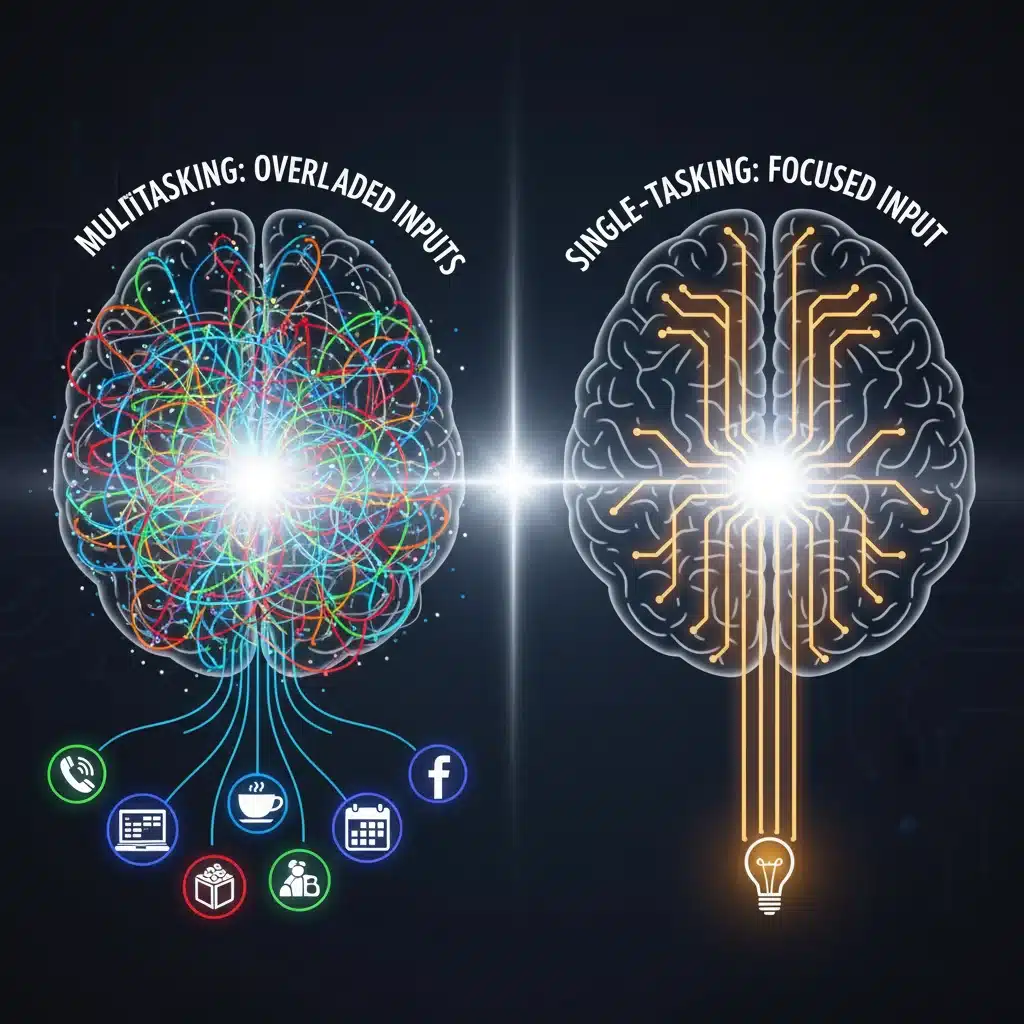
The Unquestionable Benefits of Single Tasking Productivity
If multitasking is a myth and task-switching is costly, then the logical alternative is single-tasking. This approach involves dedicating your full, undivided attention to one task at a time until it is completed or a significant portion is achieved. The benefits of adopting single tasking productivity are profound and far-reaching, impacting not only your output but also your mental well-being and overall quality of life.
1. Enhanced Focus and Concentration
When you commit to single-tasking, you train your brain to sustain attention on a single objective. This strengthens your ability to concentrate, making you less susceptible to distractions. Over time, this improved focus translates into deeper work, allowing you to tackle complex problems with greater clarity and efficiency.
2. Increased Accuracy and Quality of Work
With your full cognitive resources dedicated to one task, the likelihood of errors significantly decreases. You can pay closer attention to details, identify potential issues early, and produce work that is of a higher standard. This not only saves time on corrections but also enhances your reputation for delivering quality results.
3. Greater Efficiency and Speed
While it might seem counterintuitive, single-tasking often leads to faster completion times. By eliminating switching costs and maintaining a flow state, you can progress through tasks more smoothly and quickly. The initial investment of focus pays dividends in accelerated completion rates, directly boosting your single tasking productivity.
4. Deeper Learning and Retention
When you immerse yourself in a single subject, your brain processes information more thoroughly. This leads to better comprehension, stronger memory encoding, and a greater ability to recall and apply what you’ve learned. For continuous learners, this is an invaluable benefit.
5. Reduced Stress and Mental Fatigue
The constant pressure of juggling multiple tasks is a major source of stress. Single-tasking simplifies your workflow, reducing mental clutter and the feeling of being overwhelmed. This leads to less mental fatigue, allowing you to maintain energy and focus throughout the day, and contributing directly to your single tasking productivity.
6. Enhanced Creativity and Problem-Solving
Deep work, a natural outcome of single-tasking, is essential for creative thought and innovative problem-solving. When your mind isn’t fragmented, it can make novel connections, explore ideas more thoroughly, and arrive at more original solutions.
7. A Sense of Accomplishment
Completing one task before moving to the next provides a clear sense of achievement. This positive reinforcement motivates you and builds momentum, fostering a more positive and productive work experience. This feeling of accomplishment is a powerful driver for continued single tasking productivity.
By embracing these benefits, you’re not just changing a habit; you’re transforming your approach to work and life. The projected 30% increase in productivity by 2026 is not an exaggeration; it’s a conservative estimate of what’s possible when you truly commit to focused, single-minded effort.
Practical Strategies for Cultivating Single Tasking Productivity
Transitioning from a multitasking mindset to a single-tasking approach requires conscious effort and the implementation of effective strategies. Here are actionable techniques to help you cultivate single tasking productivity and reap its rewards:
1. The Pomodoro Technique
This popular time management method involves working in focused 25-minute intervals, separated by short breaks. During each 25-minute ‘Pomodoro,’ you commit to working on only one task. This structured approach helps train your brain to concentrate for sustained periods and provides regular opportunities to reset your focus. The short breaks prevent mental fatigue and allow for quick mental rejuvenation, making it easier to return to your single task with renewed vigor.
2. Time Blocking
Dedicated blocks of time on your calendar for specific tasks are crucial. For example, allocate 9:00 AM to 10:30 AM for writing, 10:30 AM to 11:00 AM for checking emails, and so on. During each block, commit to working on only the assigned task. This proactive scheduling eliminates decision fatigue and clearly defines your focus, significantly enhancing single tasking productivity.
3. Eliminate Distractions
This is perhaps the most critical step. Identify your biggest distractions (e.g., social media notifications, email alerts, noisy environments) and actively work to minimize them. Turn off notifications on your phone and computer, close unnecessary browser tabs, use website blockers, and consider noise-canceling headphones if your environment is noisy. Creating a distraction-free zone is paramount for deep, focused work.
4. Prioritize Your Tasks
Before you begin your workday, identify your most important task (MIT) or a few key tasks. Focus on completing these high-priority items first, before moving on to less critical ones. This ensures that your most valuable work receives your undivided attention and that you’re making progress on what truly matters. Tools like the Eisenhower Matrix or simple to-do lists can help with this prioritization.
5. Batch Similar Tasks
While the goal is single-tasking, some tasks are inherently quick and can be grouped together. For instance, dedicate a specific time slot to respond to all emails, another for making phone calls, or another for administrative tasks. This ‘batching’ prevents constant context switching between different types of activities, thereby improving overall single tasking productivity.
6. Practice Mindfulness and Meditation
Training your mind to stay in the present moment through mindfulness exercises can significantly improve your ability to focus. Even a few minutes of daily meditation can enhance your attention span and reduce mind-wandering, making it easier to commit to a single task.
7. Take Regular Breaks
Paradoxically, taking breaks is essential for sustained focus. Short, strategic breaks allow your brain to rest and recharge, preventing mental fatigue. Step away from your workspace, stretch, grab a drink, or engage in a brief, non-work-related activity. This refreshes your mind, enabling you to return to your task with renewed concentration.
8. Learn to Say ‘No’
One of the biggest obstacles to single-tasking is the pressure to take on too many responsibilities. Learning to politely decline non-essential tasks or delegate when appropriate is vital for protecting your focus and ensuring you have the time and energy for your priority work. This boundary setting is a cornerstone of effective single tasking productivity.
9. Single-Handle Communications
Avoid having multiple communication channels open simultaneously. Instead of constantly checking email, Slack, and text messages, dedicate specific times to each. For example, check email twice a day, respond to messages during designated periods, and close communication apps when working on deep tasks. This minimizes interruptions and keeps your attention where it needs to be.

The Future of Work: Embracing Single Tasking Productivity in 2026 and Beyond
As we look towards 2026, the landscape of work continues to evolve, with increasing demands for innovation, critical thinking, and high-quality output. In this environment, the ability to focus deeply on a single task will become an even more valuable skill. Organizations that recognize and foster single tasking productivity among their employees will gain a significant competitive advantage.
The shift towards remote and hybrid work models has further highlighted the need for self-discipline and effective self-management. Without the traditional office structure, individuals are often left to manage their own time and attention, making the adoption of single-tasking principles more crucial than ever. Companies can support this by:
- Promoting a Culture of Focus: Encourage employees to block out ‘deep work’ time, minimize internal interruptions, and respect each other’s focused periods.
- Providing Tools for Concentration: Invest in tools that help reduce distractions, such as project management software that centralizes communication and task lists, or noise-canceling equipment.
- Training and Education: Offer workshops on time management, mindfulness, and the science behind single-tasking to equip employees with the knowledge and skills they need.
- Redefining Productivity Metrics: Shift the focus from hours spent or number of tasks juggled to the quality and impact of completed work.
For individuals, the journey to enhanced single tasking productivity is a personal one, but it’s a journey well worth taking. It’s about retraining your brain, developing new habits, and consciously choosing focus over fragmentation. It’s about respecting your cognitive limits and optimizing your mental energy for maximum impact. The initial adjustment might feel challenging, especially if you’re accustomed to a fast-paced, multitasking rhythm. However, with consistent practice, you’ll begin to notice a profound difference in your ability to concentrate, the quality of your work, and your overall sense of well-being.
Imagine a workday where you feel less stressed, make fewer errors, complete important tasks with higher quality, and still have energy left at the end of the day. This isn’t a pipe dream; it’s the reality that single-tasking offers. By 2026, those who have mastered the art of focused work will not only be more productive but also more innovative, more resilient, and ultimately, more successful in their endeavors.
Conclusion: Unlock Your True Potential with Single Tasking Productivity
The myth of multitasking has held us captive for too long, leading to burnout, reduced quality of work, and an illusion of efficiency. The scientific evidence is clear: our brains are designed for single-minded focus, and attempting to do otherwise comes at a significant cognitive cost. By debunking these myths and embracing the power of single tasking productivity, you can unlock a remarkable increase in your output, potentially boosting your efficiency by 30% or more by 2026.
The strategies outlined in this article – from the Pomodoro Technique and time blocking to eliminating distractions and practicing mindfulness – are not just theoretical concepts. They are practical, actionable steps that you can implement today to transform your work habits. The transition requires discipline and patience, but the rewards are immense: enhanced focus, superior quality of work, reduced stress, and a profound sense of accomplishment.
In a world that constantly vies for our attention, choosing to focus on one thing at a time is a revolutionary act. It’s an investment in your cognitive health, your professional growth, and your overall well-being. Make 2026 the year you reclaim your focus, eliminate the illusion of multitasking, and truly master the art of single-tasking. Your future, more productive self will thank you.