Reclaim Your Workday: Time-Blocking for 2 Hours Daily in 2025

Time-blocking strategies involve scheduling specific tasks into dedicated time slots, a proven method to significantly enhance focus, reduce distractions, and effectively reclaim up to two hours daily in 2025 for a more productive and balanced workday.
In today’s fast-paced remote work environment, finding ways to maximize efficiency and minimize distractions is paramount. This article explores how to Reclaim Your Workday: Implementing Time-Blocking Strategies to Save 2 Hours Daily in 2025, offering a practical roadmap to greater productivity and a healthier work-life balance.
Understanding the Core of Time-Blocking
Time-blocking is more than just a scheduling technique; it’s a philosophy that transforms your workday from reactive to proactive. Instead of letting your inbox or urgent requests dictate your time, you intentionally allocate specific blocks of time for specific tasks, treating these blocks as non-negotiable appointments with yourself.
This approach demands a clear understanding of your priorities and a commitment to protecting your scheduled work. It’s about creating a structured environment where deep work can flourish, allowing you to tackle important projects without the constant pull of minor interruptions.
The philosophy of dedicated work periods
The essence of time-blocking lies in its ability to foster deep work. By dedicating uninterrupted periods to complex tasks, you minimize context-switching, which is a significant drain on cognitive resources. This focused attention not only improves the quality of your output but also dramatically reduces the time it takes to complete tasks.
- Reduces Multitasking: Forces a single-task focus, enhancing concentration.
- Increases Awareness: Provides a realistic view of how long tasks truly take.
- Boosts Productivity: Leads to more completed work of higher quality.
- Minimizes Distractions: Creates boundaries against interruptions.
Ultimately, understanding time-blocking means recognizing its power to transform your relationship with time, turning it into a valuable asset rather than a fleeting commodity. It’s a strategic move towards intentional living and working.
Setting Up Your Time-Blocking System for Success
Implementing a successful time-blocking system requires more than just drawing boxes on a calendar; it involves thoughtful preparation and consistent execution. The initial setup is crucial for establishing habits that will genuinely save you those valuable two hours each day.
Begin by auditing your current schedule to identify how your time is actually spent versus how you intend to spend it. This honest assessment is the foundation for creating realistic and effective time blocks.
Auditing your current time usage
Before you can block time effectively, you need to know where your time is currently going. For a few days, meticulously track every activity, from checking emails to attending meetings and working on projects. This will reveal patterns, common distractions, and areas where time is being wasted.
Once you have this data, categorize your tasks into high-priority, medium-priority, and low-priority. This hierarchy will guide your time-blocking decisions, ensuring that your most important work receives dedicated attention.
- Identify Time Wasters: Pinpoint activities that consume time without adding significant value.
- Analyze Workflows: Understand the typical flow of your day and week.
- Prioritize Tasks: Differentiate between urgent and important tasks.
- Recognize Peak Productivity Times: Schedule demanding tasks during your most energetic hours.
Establishing a robust time-blocking system is an investment in your productivity, ensuring that every minute of your workday contributes meaningfully to your goals.
Practical Steps to Implement Time-Blocking Daily
Once you understand the principles and have audited your time, the next step is to put time-blocking into practice. This involves a series of practical, actionable steps that can be integrated into your daily routine, leading to tangible improvements in your productivity and time management.
Starting small and gradually building up your time-blocking habit is often the most effective approach. Don’t try to overhaul your entire schedule overnight; instead, focus on blocking out key activities first.
Scheduling your day with intention
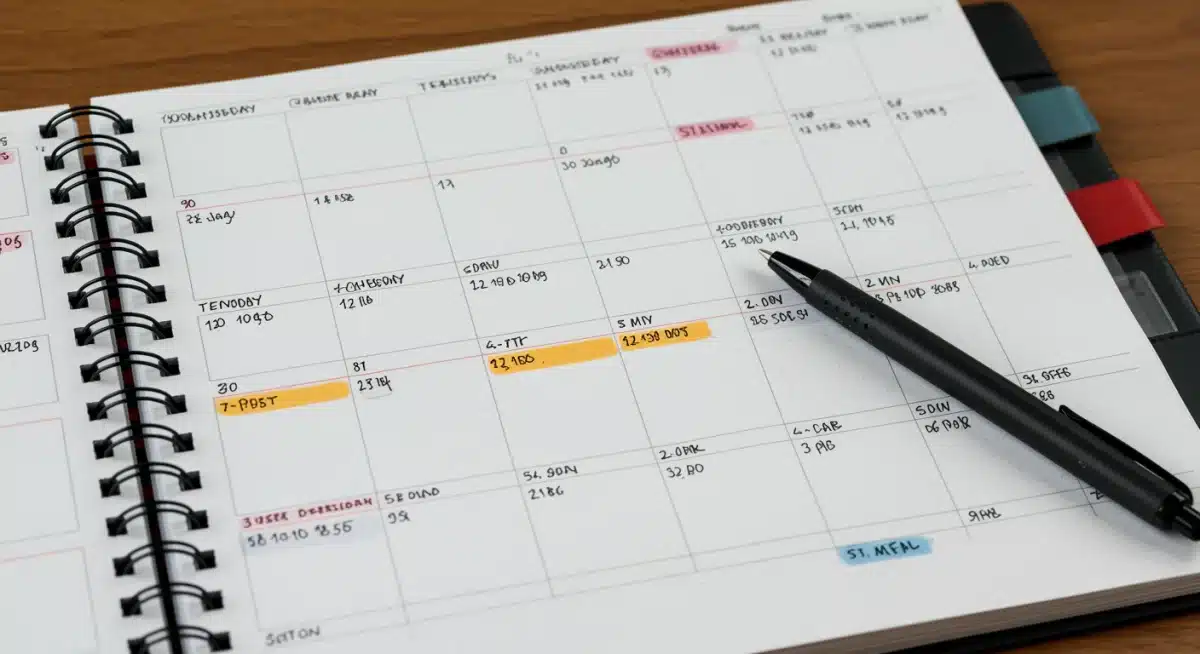
The core of daily implementation is intentional scheduling. At the beginning of each day, or even the night before, review your tasks and allocate specific time slots for each. Use a digital calendar like Google Calendar or Outlook Calendar, or a physical planner, to visually represent your blocks.
Color-coding different types of tasks (e.g., green for deep work, blue for meetings, yellow for communication) can provide a quick visual overview of your day and help you maintain focus. Remember to include buffer time between blocks to account for unexpected delays or quick breaks.
- Define Task Blocks: Assign specific tasks to specific time slots.
- Color-Code for Clarity: Use colors to differentiate task categories.
- Include Buffer Time: Allow for transitions and unexpected events.
- Review and Adjust: Regularly evaluate and refine your schedule.
By consciously structuring your day, you take control of your time, ensuring that your most important work gets done and you move closer to saving two hours daily.
Overcoming Common Time-Blocking Challenges
While time-blocking offers immense benefits, it’s not without its challenges. Distractions, unexpected interruptions, and the temptation to deviate from your schedule can derail even the most well-intentioned plans. Recognizing and addressing these obstacles is key to maintaining consistency and achieving long-term success.
The ability to adapt and persevere through these challenges is what distinguishes effective time-blockers from those who struggle. It requires a resilient mindset and a commitment to continuous improvement.
Dealing with interruptions and flexibility
One of the biggest hurdles in time-blocking is managing interruptions. While it’s impossible to eliminate all disruptions, you can implement strategies to minimize their impact. Communicate your time-blocking schedule to colleagues, setting expectations about when you’re available for urgent matters and when you’re in a focused work block.
Building flexibility into your schedule is also crucial. Instead of viewing your time blocks as rigid, unchangeable appointments, see them as a guiding framework. If an urgent task arises that genuinely requires immediate attention, be prepared to adjust your blocks, but always reschedule the displaced task rather than abandoning it.
- Communicate Boundaries: Inform colleagues about your focus times.
- Schedule Response Times: Dedicate specific blocks for emails and messages.
- Incorporate Flex Blocks: Allocate time for unexpected tasks or breaks.
- Review and Adapt: Learn from disruptions and refine your approach.
Addressing these challenges head-on will strengthen your time-blocking practice, making it a sustainable and effective tool for regaining control over your workday.
Leveraging Tools and Technology for Enhanced Time-Blocking
In 2025, a plethora of digital tools and technologies are available to support and enhance your time-blocking efforts. These resources can automate aspects of scheduling, provide reminders, and help you track your progress, making the process smoother and more efficient.
Integrating technology thoughtfully can amplify the benefits of time-blocking, turning it from a manual effort into a streamlined system that works in harmony with your digital life.
Digital calendars and productivity apps
Modern digital calendars like Google Calendar, Outlook Calendar, and Apple Calendar are indispensable for time-blocking. They allow for easy creation of recurring blocks, color-coding, and setting reminders. Many also integrate with other productivity apps, creating a seamless ecosystem for task management.
Beyond basic calendars, dedicated productivity apps like Todoist, Trello, or Asana can help you manage your task list, allowing you to drag and drop tasks directly into your calendar blocks. Focus apps like Forest or Freedom can also help enforce your blocked time by temporarily blocking distracting websites and applications.
- Utilize Calendar Features: Leverage recurring events, color-coding, and reminders.
- Integrate Task Managers: Connect your task list with your calendar for seamless planning.
- Employ Focus Apps: Use tools to minimize digital distractions during deep work.
- Explore Automation: Look for ways to automate routine scheduling tasks.
By strategically using these tools, you can optimize your time-blocking process, making it easier to stick to your schedule and consistently save those precious two hours daily.
Measuring Your Progress and Sustaining the Habit
Implementing time-blocking is an ongoing process that requires continuous measurement, evaluation, and adaptation. To truly save two hours daily and sustain this efficiency, you need to regularly assess your progress and refine your strategies. This reflective practice ensures that your system remains effective and aligned with your evolving needs.
Without consistent review, even the best time-blocking system can lose its effectiveness. It’s about building a feedback loop that helps you optimize your approach over time.
Tracking time and refining your approach
Regularly tracking how you spend your time versus your blocked schedule is crucial. Tools like Toggl Track or Clockify can provide valuable insights into where your time is actually going. Compare your actual time usage with your planned blocks to identify discrepancies and understand why they occurred.
Based on this data, be prepared to adjust your time blocks, task durations, and even your overall daily structure. Perhaps certain tasks consistently take longer than anticipated, or you find yourself more productive during different times of the day. Flexibility and a willingness to iterate are vital for long-term success.
- Monitor Actual vs. Planned Time: Use time-tracking tools to compare.
- Identify Bottlenecks: Pinpoint areas where your schedule breaks down.
- Adjust Block Durations: Fine-tune the time allocated for each task.
- Experiment with Structures: Try different daily and weekly time-blocking layouts.
By actively measuring your progress and continuously refining your time-blocking approach, you can ensure that you not only save two hours daily but also build a sustainable habit for enhanced productivity and work-life balance in 2025 and beyond.
| Key Point | Brief Description |
|---|---|
| Proactive Scheduling | Dedicate specific time blocks for tasks, treating them as non-negotiable appointments. |
| Time Audit | Track current time usage to identify waste and prioritize high-value activities effectively. |
| Manage Interruptions | Communicate boundaries and build flexibility into your schedule to handle unexpected events. |
| Leverage Technology | Utilize digital calendars and productivity apps to automate and streamline time-blocking efforts. |
Frequently asked questions about time-blocking
Time-blocking involves scheduling specific tasks into dedicated calendar slots, treating them as appointments. Unlike a simple to-do list, which only outlines tasks, time-blocking assigns a fixed time for each task, ensuring focused work and reducing procrastination. It transforms intentions into concrete plans, boosting productivity significantly.
By dedicating specific blocks to high-priority tasks and minimizing context-switching, time-blocking reduces wasted time and boosts efficiency. It helps you avoid distractions and ensures critical work gets done, often cutting down the total time needed for tasks. This intentional focus can easily free up two hours or more each day.
Interruptions are inevitable. The key is to manage them. Politely defer non-urgent requests, communicate your focus times to colleagues, and build buffer time into your schedule. If an urgent interruption occurs, address it quickly, then immediately return to your blocked task or reschedule it for another dedicated block.
Yes, time-blocking can be highly beneficial for creative work. Instead of blocking specific tasks, you can block ‘creative time’ or ‘idea generation’ blocks. This provides dedicated space for deep work without rigid task constraints. For unpredictable work, schedule ‘flex blocks’ to handle emergent tasks, maintaining structure while allowing adaptability.
Digital calendars like Google Calendar, Outlook Calendar, or Apple Calendar are excellent for creating and managing time blocks. Productivity apps like Todoist or Asana can integrate with your calendar for task management. For focus, consider apps like Forest or Freedom to minimize digital distractions during your dedicated work periods.
Conclusion
Embracing time-blocking strategies in 2025 is more than a productivity hack; it’s a fundamental shift towards intentional living and working. By proactively scheduling your day, auditing your time, and leveraging available tools, you gain unparalleled control over your workday. The consistent application of these methods not only promises to save you two hours daily but also fosters a more balanced and less stressful professional life, transforming your approach to remote work and beyond.