Freelance Retirement Planning 2026: Maximize Solo 401(k) Contributions

Anúncios
The Latest in Freelance Retirement Planning for 2026: Maximizing Your Solo 401(k) Contributions
As a freelancer or self-employed individual, the responsibility of planning for your retirement falls squarely on your shoulders. Unlike traditional employees who often benefit from employer-sponsored 401(k)s, you need to proactively seek out and utilize the best retirement vehicles available. Among these, the Solo 401(k) stands out as an exceptionally powerful tool, offering significant advantages for maximizing your retirement savings. For 2026, understanding the nuances of Solo 401(k) contributions is more crucial than ever to ensure you’re building a robust financial future.
The landscape of retirement planning is ever-evolving, with IRS regulations and economic factors constantly shifting. Staying informed about the latest contribution limits, eligibility requirements, and strategic approaches can make a substantial difference in your long-term wealth accumulation. This comprehensive guide will delve deep into maximizing your Solo 401(k) contributions for 2026, providing you with the knowledge and strategies to optimize your retirement savings as a self-employed professional.
Anúncios
What is a Solo 401(k) and Why is it Ideal for Freelancers?
Before we dive into the specifics of 2026, let’s establish a foundational understanding of what a Solo 401(k) is and why it’s often considered the gold standard for self-employed individuals. Also known as an individual 401(k) or one-participant 401(k), a Solo 401(k) is a retirement plan designed specifically for business owners with no full-time employees other than themselves (and their spouse, if applicable).
The primary appeal of the Solo 401(k) lies in its dual contribution mechanism. Unlike a traditional IRA or SEP IRA, which have lower annual contribution limits, the Solo 401(k) allows you to contribute to your retirement savings in two capacities: as both an employee and an employer. This unique structure enables significantly higher annual contributions, accelerating your path to financial independence.
Anúncios
Key Advantages of a Solo 401(k):
- High Contribution Limits: As mentioned, you can contribute both as an employee and an employer, leading to much larger annual contributions.
- Tax Benefits: Contributions are typically tax-deductible, reducing your taxable income in the present. Earnings grow tax-deferred until retirement.
- Roth Option: Many Solo 401(k) plans offer a Roth option for employee contributions, allowing for tax-free withdrawals in retirement.
- Loan Provision: Some plans allow you to borrow from your Solo 401(k), providing a source of funds if needed (though this should be approached with caution).
- Investment Flexibility: You often have a wide range of investment options, including stocks, bonds, mutual funds, and even real estate.
- Simplified Administration: Compared to a traditional 401(k) for businesses with multiple employees, the administrative burden for a Solo 401(k) is significantly lighter.
For freelancers, consultants, independent contractors, and small business owners without employees, the Solo 401(k) is a game-changer. It empowers you to save for retirement with the same, if not greater, efficiency as employees of large corporations, all while enjoying the flexibility and control of self-employment. Understanding and utilizing Solo 401(k) contributions is paramount for securing your future.
Understanding Solo 401(k) Contribution Limits for 2026
The core of maximizing your Solo 401(k) contributions lies in understanding the annual limits set by the IRS. While the exact figures for 2026 are usually released late in the preceding year or early in the new year, we can project based on historical adjustments and inflation. It’s crucial to consult the official IRS guidelines for the most accurate and up-to-date numbers once they are published.
The Solo 401(k) allows for two types of contributions:
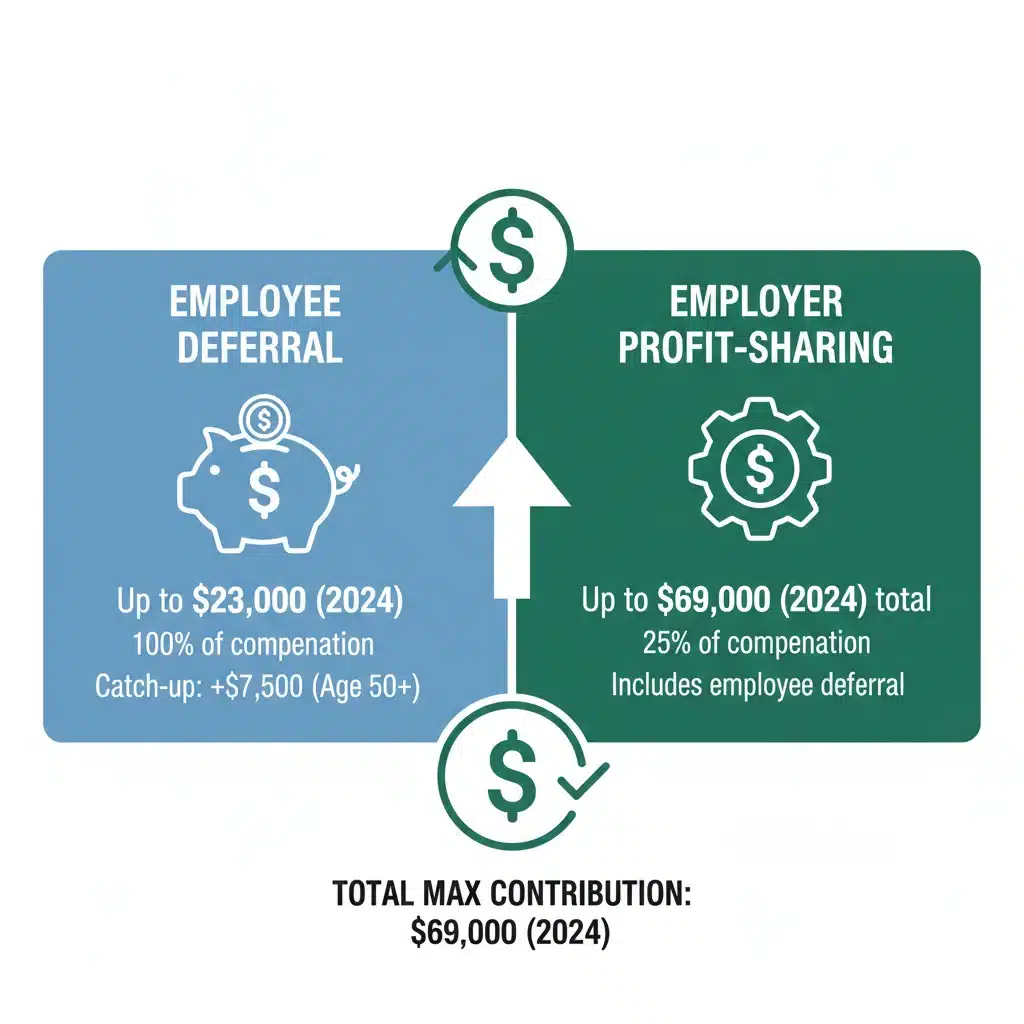
1. Employee Contributions (Elective Deferrals):
As the employee of your own business, you can contribute up to 100% of your net earnings from self-employment, up to a certain annual limit. For 2025, this limit was $23,000, and for those aged 50 or older, an additional catch-up contribution of $7,500 was allowed, bringing the total to $30,500. We can anticipate slight increases for 2026 due to inflation, potentially pushing these figures higher. These contributions can be made pre-tax (traditional) or after-tax (Roth), depending on your plan’s offerings and your tax strategy.
2. Employer Contributions (Profit-Sharing Contributions):
As the employer, your business can make profit-sharing contributions on your behalf. This contribution is generally limited to 25% of your net earnings from self-employment, after deducting one-half of your self-employment tax and the plan contributions themselves. The calculation for this can be a bit tricky, often working out to be about 20% of your gross self-employment income.
Total Contribution Limit:
The combined total of your employee and employer contributions cannot exceed a specified annual limit. For 2025, this limit was $69,000, or $76,500 if you were age 50 or older and made the catch-up contribution. These figures are also likely to see an upward adjustment for 2026. This total limit is where the Solo 401(k) truly shines, allowing for significantly higher savings than other self-employed retirement plans.
It’s important to remember that ‘net earnings from self-employment’ is a critical figure here. This is your gross income from your business minus your business expenses and one-half of your self-employment tax. Accurate accounting is essential for calculating your maximum Solo 401(k) contributions.
Strategies for Maximizing Your Solo 401(k) Contributions in 2026
Simply knowing the limits isn’t enough; you need a strategy to effectively maximize your Solo 401(k) contributions. Here’s how to approach it for 2026:
1. Understand Your Net Earnings from Self-Employment:
This is the bedrock of your Solo 401(k) contributions. Before you can determine how much you can contribute, you need an accurate picture of your net income. This involves meticulous record-keeping of all your business income and deductible expenses. Tools like accounting software (e.g., QuickBooks Self-Employed, FreshBooks) can be invaluable here.
2. Prioritize Employee Contributions:
Always aim to max out your employee deferral first. This is typically the easiest part to calculate and contribute. If your plan offers a Roth option, consider splitting your contributions between traditional (pre-tax) and Roth (after-tax) based on your current and projected future tax brackets. A financial advisor can help you determine the optimal strategy.
3. Maximize Employer Profit-Sharing Contributions:
After your employee contributions, focus on the employer profit-sharing component. This is where the Solo 401(k) truly pulls ahead of other plans. The 20% (approx.) of net earnings can add a substantial amount to your retirement nest egg. For example, if your net earnings are $100,000, you could potentially contribute around $20,000 as an employer, in addition to your employee contribution.
4. Don’t Forget Catch-Up Contributions (Age 50+):
If you are age 50 or older by the end of the tax year, you are eligible to make additional catch-up contributions. For 2025, this was $7,500, and it’s likely to increase for 2026. This is a significant advantage for those who may have started saving later or want to supercharge their retirement savings in their prime earning years.
5. Consider a Roth Solo 401(k) for Employee Deferrals:
While employer contributions are always pre-tax, many Solo 401(k) plans allow you to designate your employee deferrals as Roth contributions. This means you contribute after-tax dollars, but your qualified withdrawals in retirement are completely tax-free. This can be incredibly beneficial if you anticipate being in a higher tax bracket in retirement than you are now.
6. Make Contributions Early (If Possible):
While you have until your tax filing deadline (including extensions) to make employer contributions, and until December 31st of the plan year for employee deferrals, contributing earlier in the year allows your money more time to grow tax-deferred. This power of compounding is one of your greatest allies in retirement planning.
7. Consult with a Financial Advisor and Tax Professional:
The calculations for Solo 401(k) contributions, especially the employer profit-sharing portion, can be complex. A qualified financial advisor can help you determine your optimal contribution strategy based on your income, age, and financial goals. A tax professional can ensure you’re compliant with all IRS regulations and taking advantage of all eligible deductions.
Calculating Your Solo 401(k) Contributions: A Practical Example for 2026
Let’s walk through a hypothetical example to illustrate how Solo 401(k) contributions might work for a freelancer in 2026. For this example, we’ll use projected 2026 limits, assuming a modest increase from 2025 figures.
Assumptions for our Freelancer, ‘Sarah’:
- Gross Self-Employment Income: $150,000
- Business Expenses: $30,000
- Age: 45 (not eligible for catch-up contributions)
- Projected 2026 Employee Contribution Limit: $24,000
- Projected 2026 Total Contribution Limit: $71,000
Step 1: Calculate Net Earnings from Self-Employment
First, calculate Sarah’s net income before deducting one-half of her self-employment tax. This is crucial for determining both the self-employment tax and the basis for employer contributions.
Gross Income – Business Expenses = Net Profit
$150,000 – $30,000 = $120,000
Next, calculate the self-employment tax. For 2026, the self-employment tax rate is 15.3% on the first $168,600 (2024 figure, likely higher for 2026) of net earnings, which covers Social Security (12.4%) and Medicare (2.9%). You can deduct one-half of your self-employment tax when calculating your adjusted gross income.
Net Profit x 92.35% (to account for the deductible portion of SE tax) = Net Earnings for SE Tax Calculation
$120,000 x 0.9235 = $110,820
Self-Employment Tax = $110,820 x 0.153 = $16,955.46
Deductible Portion of SE Tax = $16,955.46 / 2 = $8,477.73
Net Earnings from Self-Employment for Solo 401(k) purposes:
$120,000 (Net Profit) – $8,477.73 (Deductible SE Tax) = $111,522.27
Step 2: Calculate Employee Contribution
Sarah can contribute up to 100% of her net earnings from self-employment as an employee, up to the annual limit.
Employee Contribution = Min($111,522.27, $24,000)
Sarah’s Employee Contribution = $24,000
Step 3: Calculate Employer Profit-Sharing Contribution
The employer contribution is generally 25% of your ‘compensation.’ For self-employed individuals, ‘compensation’ is your net earnings from self-employment (after deducting one-half of self-employment taxes and the employee contribution). A simpler way to think about it for calculation purposes is often 20% of your net earnings from self-employment before deducting the plan contributions.
Using the 20% rule of thumb on the $111,522.27 figure:
Employer Contribution = $111,522.27 x 0.20 = $22,304.45
Let’s verify using the more precise calculation of 25% of compensation, where compensation is Net Earnings from Self-Employment minus employee deferral:
Compensation for employer contribution = $111,522.27 – $24,000 = $87,522.27
Employer Contribution = $87,522.27 x 0.25 = $21,880.57
Let’s use the precise calculation here. Sarah’s Employer Contribution = $21,880.57
Step 4: Calculate Total Solo 401(k) Contributions
Total Contribution = Employee Contribution + Employer Contribution
$24,000 + $21,880.57 = $45,880.57
This total must also be less than the overall projected limit of $71,000 for 2026, which it is. Therefore, Sarah can contribute a total of $45,880.57 to her Solo 401(k) in 2026.
This example highlights the power of the Solo 401(k). With a gross income of $150,000, Sarah can potentially save over $45,000 for retirement in a single year, significantly more than what would be possible with an IRA or even a SEP IRA.
Opening and Administering Your Solo 401(k)
The process of setting up and managing a Solo 401(k) is relatively straightforward, but it does require attention to detail.
Choosing a Provider:
Several financial institutions offer Solo 401(k) plans, including brokerage firms like Fidelity, Schwab, Vanguard, and specialized Solo 401(k) providers. When choosing a provider, consider:
- Fees: Look for low administrative fees and investment costs.
- Investment Options: Ensure the provider offers a wide range of investments that align with your strategy.
- Customer Service: Good support can be invaluable, especially if you have questions about contributions or compliance.
- Roth Option: If you’re interested in Roth contributions, confirm the provider offers this feature.
Setting Up the Plan:
Typically, you’ll need to complete an adoption agreement and a plan document. You’ll also need to obtain an Employer Identification Number (EIN) from the IRS for your business, even if you’re a sole proprietor without employees. This EIN is separate from your Social Security number and is required for the Solo 401(k) to function as a business plan.
Making Contributions:
You’ll typically set up separate accounts for your employee and employer contributions, although they fall under the umbrella of the single Solo 401(k) plan. Employee contributions are usually made as direct transfers from your business bank account, while employer contributions are also made from your business’s funds.
Reporting Requirements:
For most Solo 401(k) plans, if the total plan assets exceed $250,000 at the end of the plan year, you will need to file Form 5500-EZ with the IRS. This form reports information about your retirement plan. Your plan provider may assist with this, but it’s ultimately your responsibility to ensure compliance.

Advanced Strategies and Considerations for Solo 401(k) Owners
Beyond simply maximizing your Solo 401(k) contributions, there are several advanced strategies and considerations that can further enhance your retirement planning.
Backdoor Roth Contributions (If Applicable):
While Solo 401(k)s allow Roth employee contributions, if you also have a traditional IRA and your income is too high to contribute directly to a Roth IRA, you might consider a ‘backdoor Roth’ strategy. However, be aware of the ‘pro-rata’ rule if you have pre-tax IRA money. Having a Solo 401(k) with a Roth sub-account can simplify matters by allowing direct Roth contributions within the 401(k) structure.
Mega Backdoor Roth (Advanced):
This is a more advanced strategy that involves making after-tax non-Roth contributions to your Solo 401(k), and then converting those after-tax contributions to a Roth account. This allows you to bypass income limits for Roth contributions and potentially contribute a significant amount more to a Roth account than the standard limits. Not all Solo 401(k) providers support this, so check with yours if this strategy interests you.
Integrating with Other Retirement Accounts:
If you also have a W-2 job in addition to your freelance work, and contribute to an employer-sponsored 401(k) there, your employee contribution limit is shared across all 401(k) plans. However, your employer contributions to your Solo 401(k) are separate and not affected by contributions to a W-2 401(k). This can be a powerful way to supercharge your savings if you have both types of income.
Investment Strategy within Your Solo 401(k):
Once your Solo 401(k) contributions are made, the next step is to invest them wisely. Develop an investment strategy that aligns with your risk tolerance, time horizon, and financial goals. Diversify your portfolio across different asset classes, and regularly review and rebalance your investments. Consider low-cost index funds or ETFs for broad market exposure.
Regular Review and Adjustment:
Your income, expenses, and retirement goals may change over time. It’s essential to review your Solo 401(k) contribution strategy annually. As your business grows, you may be able to contribute more. Conversely, if your income fluctuates, you might need to adjust your contributions accordingly. Staying flexible and proactive is key.
Potential Pitfalls and How to Avoid Them
While the Solo 401(k) is an excellent tool, there are a few potential pitfalls to be aware of:
- Incorrect Calculations: Miscalculating your net earnings from self-employment or your contribution limits can lead to penalties from the IRS. Always double-check your figures or consult with a professional.
- Missed Deadlines: Employee contributions must be made by December 31st of the plan year. Employer contributions can be made up to your tax filing deadline (including extensions). Missing these can lead to missed savings opportunities or penalties.
- Hiring Employees: If you hire full-time employees (not including your spouse), your Solo 401(k) will no longer be eligible as a ‘one-participant’ plan. You’ll need to convert it to a traditional 401(k) or explore other options, which comes with increased administrative complexity.
- Ignoring Investment Performance: Simply contributing isn’t enough; your investments need to be working for you. Neglecting your investment strategy can hinder your retirement growth.
Conclusion: Secure Your Freelance Future with Strategic Solo 401(k) Contributions
For freelancers and self-employed individuals, taking control of your retirement planning is not just an option, but a necessity. The Solo 401(k) remains one of the most powerful and flexible retirement vehicles available, offering unparalleled opportunities to maximize your savings.
By understanding the projected Solo 401(k) contributions limits for 2026, meticulously calculating your net earnings, and implementing a strategic approach to both employee and employer contributions, you can build a formidable retirement nest egg. Don’t underestimate the power of consistent, maximized contributions combined with smart investing.
Start planning now for 2026. Review your business income and expenses, consult with financial and tax professionals, and ensure your Solo 401(k) is working as hard as you are. Your future self will thank you for the diligence and foresight you put into maximizing your Solo 401(k) contributions today.
Embrace the freedom of freelancing with the security of a well-funded retirement. The tools are available; it’s up to you to wield them effectively.