Digital Nomad Legal Guide US 2026: Rights, Taxes, and Visas

Anúncios
The allure of working remotely, traveling the world, and experiencing diverse cultures has propelled the digital nomad lifestyle into the mainstream. As we approach 2026, the United States, with its vibrant economy and diverse landscapes, continues to attract a significant number of these location-independent professionals. However, navigating the intricate legal landscape of the US as a digital nomad presents a unique set of challenges and responsibilities. Understanding the **digital nomad US legal** framework is not just advisable; it’s absolutely essential for sustainable and compliant remote work.
This comprehensive guide aims to demystify the legal frameworks governing digital nomads in the US for 2026. From visa requirements and tax obligations to healthcare and business compliance, we will delve into the critical aspects that every digital nomad must consider. The goal is to provide a clear roadmap, empowering you to make informed decisions and ensure your journey as a remote worker in the US is both successful and legally sound.
Anúncios
Understanding the Definition of a Digital Nomad in the US Context
Before diving into specific legalities, it’s crucial to define what constitutes a digital nomad from a US perspective. Generally, a digital nomad is an individual who leverages technology to work remotely, often while traveling or living in various locations. For US legal purposes, the distinction often hinges on citizenship, residency status, and the source of income. Are you a US citizen working remotely from within the US? A US citizen working remotely from abroad? Or a foreign national seeking to work remotely from within the US?
Each scenario presents different implications for the **digital nomad US legal** framework. US citizens working remotely within the country generally face fewer immigration hurdles but must still contend with state-specific tax and business registration laws. Foreign nationals, on the other hand, encounter the most complex challenges, primarily concerning visa categories and the legality of performing work while physically present in the US.
Anúncios
Visa Requirements for Foreign Digital Nomads in the US (2026 Outlook)
One of the most critical aspects for foreign digital nomads looking to operate from the US is securing the appropriate visa. Unlike some other countries that have introduced specific digital nomad visas, the US currently does not offer a dedicated visa category for this purpose. This means foreign nationals must navigate existing visa classifications, which were not designed with remote work in mind.
The B1/B2 Visa Dilemma
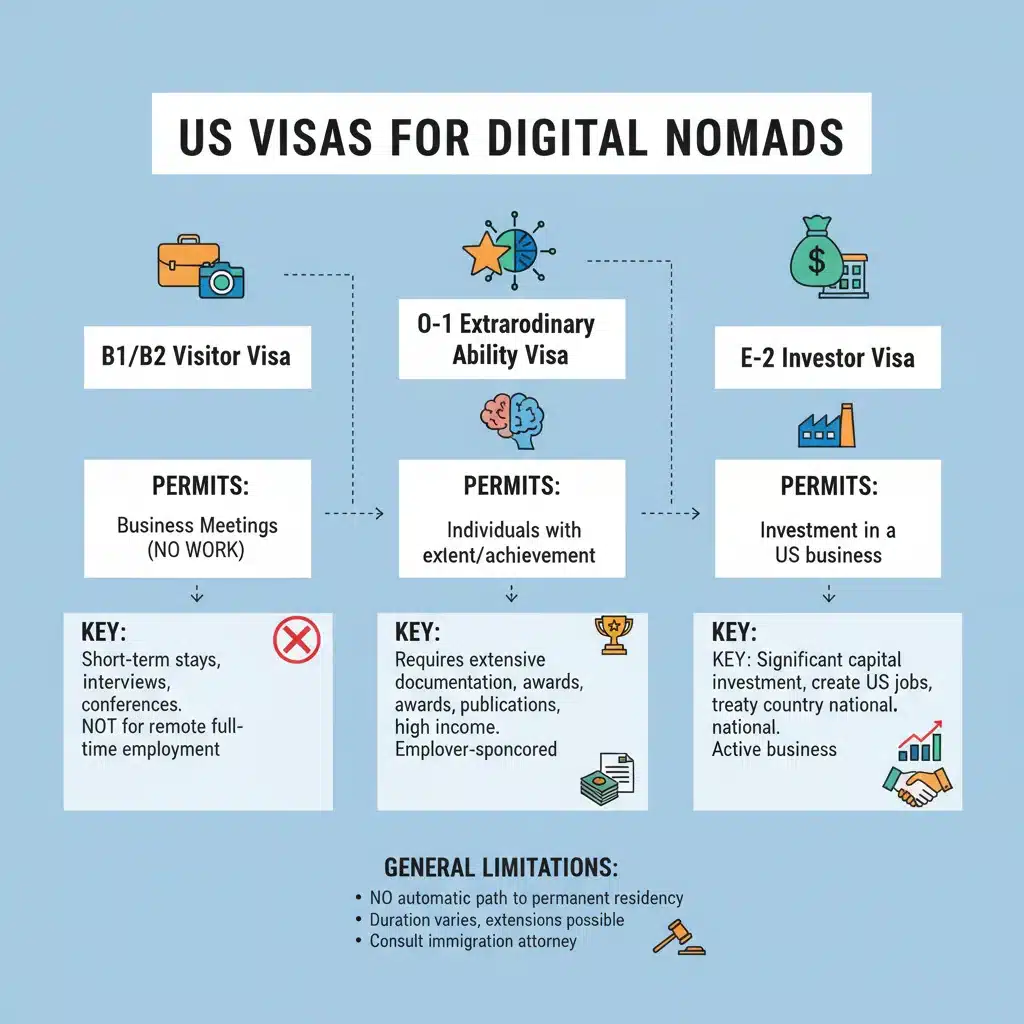
The B1 (Business Visitor) and B2 (Tourist Visitor) visas are often the first consideration, but they come with significant limitations. A B1 visa allows individuals to engage in business activities such as attending conferences, negotiating contracts, or consulting with business associates. However, it explicitly prohibits engaging in local employment or receiving payment from a US source for work performed within the US. While some digital nomads might argue their remote work for a foreign employer doesn’t constitute ‘local employment,’ the US Citizenship and Immigration Services (USCIS) tends to interpret ‘work’ broadly. Performing work, even for a foreign entity, while physically present in the US on a B1 visa can be seen as violating the terms of your stay, leading to serious consequences, including visa cancellation and future entry bans.
The B2 visa is purely for tourism and recreational purposes, making it even less suitable for digital nomads intending to work. Therefore, relying solely on a B1/B2 visa for extended remote work in the US is a risky strategy and generally not recommended for those intending to actively work for pay.
Exploring Work-Authorized Visa Options
For foreign nationals who genuinely wish to work remotely from the US, exploring work-authorized visas is imperative. These visas are typically tied to specific employment or investment and are significantly more difficult to obtain without a direct US employer or substantial investment.
- H-1B Visa (Specialty Occupations): This visa is for individuals in specialty occupations requiring a bachelor’s degree or higher. It requires a US employer to sponsor the applicant, and the job must meet specific criteria. The H-1B is subject to an annual cap and a lottery system, making it highly competitive. For a digital nomad, this would typically mean being employed by a US company that allows remote work.
- L-1 Visa (Intracompany Transferee): This visa is for employees of international companies who are being transferred to a parent, subsidiary, affiliate, or branch office in the US. It requires the individual to have worked for the foreign company for at least one continuous year within the three years preceding their application. This could be an option for digital nomads whose international employers have a US presence and are willing to transfer them.
- O-1 Visa (Individuals with Extraordinary Ability or Achievement): This visa is for individuals who possess extraordinary ability in the sciences, arts, education, business, or athletics, or who have a demonstrated record of extraordinary achievement in the motion picture or television industry. While highly specialized, some highly successful freelance digital professionals might qualify if they can demonstrate national or international acclaim in their field.
- E-1/E-2 Visas (Treaty Traders and Investors): These visas are available to citizens of countries with which the US maintains treaties of commerce and navigation. E-1 is for individuals engaging in substantial trade with the US, while E-2 is for those investing a substantial amount of capital in a US enterprise. For an entrepreneurial digital nomad, establishing a US business and making a significant investment could be a pathway, though it requires considerable capital and commitment.
- J-1 Visa (Exchange Visitor Program): While primarily for cultural and educational exchange, certain categories within the J-1 program, such as intern or trainee, might allow for some work experience in the US. However, these are generally temporary and tied to specific programs, not broad remote work.
The absence of a specific **digital nomad US legal** visa category means careful planning and often significant investment or sponsorship are required for foreign nationals to legally work remotely from within the US. Consulting with an immigration attorney is paramount to assess individual circumstances and identify the most suitable, compliant visa pathway.
Tax Implications for Digital Nomads in the US (2026)
Taxation is another complex area for digital nomads, especially given the dual layers of federal and state taxes in the US. The tax obligations depend heavily on your citizenship, residency status, and the duration of your stay.
US Citizens and Green Card Holders
US citizens and green card holders are subject to US taxation on their worldwide income, regardless of where they reside or work. If you are a US citizen digital nomad working from within the US, you will pay federal and potentially state income taxes. If you are a US citizen working abroad, you might be able to exclude a portion of your foreign-earned income using the Foreign Earned Income Exclusion (FEIE) or claim foreign tax credits to avoid double taxation. However, you still have US tax filing obligations.
Foreign Nationals Residing in the US
For foreign nationals, tax residency is determined by the Substantial Presence Test or the Green Card Test. If you meet the Substantial Presence Test (generally, physically present in the US for at least 31 days in the current year and 183 days over a three-year period, counting all days in the current year, 1/3 of the days in the first preceding year, and 1/6 of the days in the second preceding year), you are considered a resident alien for tax purposes and are taxed on your worldwide income, similar to a US citizen.
If you do not meet the Substantial Presence Test, you are generally considered a non-resident alien for tax purposes. Non-resident aliens are typically only taxed on US-sourced income. The challenge for digital nomads is determining the ‘source’ of their income. If you are physically present in the US and performing work, even for a foreign employer, the IRS may consider that income to be US-sourced, making it taxable. This is a critical point where the legality of your visa status and your tax obligations intersect.
State Income Taxes
Beyond federal taxes, many US states also impose income taxes. If you establish residency in a particular state or spend a significant amount of time working within a state, you may become subject to that state’s income tax laws. Some states have no state income tax (e.g., Florida, Texas, Nevada, Washington), which can be attractive for digital nomads, but you must still comply with their residency requirements. Establishing residency can involve factors like obtaining a driver’s license, registering to vote, or maintaining a physical address in the state.
Sales Tax and Other Business Taxes
If your digital nomad business involves selling products or services, you might also be subject to sales tax in states where you have a ‘nexus’ (a significant presence). This can be triggered by having employees, physical offices, or even storing inventory in a state. Furthermore, some states and localities levy business income taxes or gross receipts taxes. Understanding these obligations is crucial for any self-employed digital nomad.
Given the complexity, professional tax advice from an accountant specializing in international taxation or digital nomad finances is highly recommended to ensure compliance and optimize your tax strategy.
Healthcare and Insurance for Digital Nomads in the US
Healthcare in the US is predominantly private and can be extremely expensive without adequate insurance. This is a major concern for digital nomads.
For US Citizens and Green Card Holders
If you are a US citizen or green card holder, you are generally expected to have health insurance. You can obtain coverage through an employer, through the Affordable Care Act (ACA) marketplace, or directly from private insurers. If you are working as a freelancer or independent contractor, you will likely need to purchase your own plan. Moving between states can complicate matters, as insurance networks and plan availability vary by state.
For Foreign Nationals
Foreign nationals in the US, especially those on non-immigrant visas, often need to secure private health insurance. Travel insurance plans can offer some coverage for emergencies but may not be comprehensive enough for long-term stays or routine medical care. It’s vital to research and purchase a robust international health insurance policy that covers medical expenses in the US, which can be significantly higher than in many other countries.
Some work-authorized visas may require you to have specific health insurance coverage. Always check the requirements associated with your visa category. Neglecting health insurance in the US can lead to devastating financial consequences in the event of an illness or accident.

Business Registration and Compliance for Self-Employed Digital Nomads
Many digital nomads operate as freelancers, independent contractors, or small business owners. Understanding business registration and compliance is essential, even if your business is entirely online.
Entity Formation
You might choose to operate as a sole proprietorship, a Limited Liability Company (LLC), or even a corporation. Each structure has different implications for liability, taxation, and administrative burden. Forming an LLC, for example, can provide personal liability protection. The registration process typically occurs at the state level. If you are a foreign national, forming a US-based entity might be possible, but it doesn’t automatically grant you the right to work in the US without the appropriate visa.
Employer Identification Number (EIN)
If you form a business entity or hire employees (even contractors), you will likely need an Employer Identification Number (EIN) from the IRS. This is essentially a social security number for businesses.
Licenses and Permits
Depending on your industry and location, you may need specific business licenses or permits from state or local governments. For instance, certain professional services or online businesses might have specific regulatory requirements. Researching these at the local and state level is crucial.
Contract Law and Intellectual Property
As a digital nomad, you will likely enter into various contracts with clients. Understanding US contract law, especially concerning jurisdiction and dispute resolution, is vital. Protecting your intellectual property (copyrights, trademarks) is also a key consideration, and US laws offer robust protections, which you should leverage if your business creates original content or branding.
State-Specific Considerations for Digital Nomads
The US is a federation of states, and each state has its own laws and regulations that can significantly impact digital nomads. While federal laws govern immigration and some aspects of taxation, state laws dictate many other areas.
Residency and Domicile
Establishing residency and domicile in a particular state is important for tax purposes, voting rights, driver’s licenses, and even tuition rates if you consider higher education. States have different criteria for determining residency, often involving factors like the amount of time spent there, where your mail is received, where your vehicles are registered, and your intent to return.
Driver’s Licenses and Vehicle Registration
If you plan to drive in the US, you’ll need a valid driver’s license. Foreign nationals may use their home country’s license for a certain period, often coupled with an International Driving Permit, but eventually, a state-issued license will be necessary for longer stays. Registering a vehicle also ties you to a particular state and involves insurance requirements.
Remote Work Legislation and Employee Rights
While many digital nomads are self-employed, some may work for US companies remotely. States have varying laws regarding employee rights, minimum wage, workers’ compensation, and unemployment benefits. Understanding these if you are an employee, or your obligations if you are an employer, is crucial.
Future Trends and Changes in 2026 for Digital Nomads in the US
The landscape for digital nomads is constantly evolving. While the US has been slower than some other nations to adapt its immigration policies to this trend, discussions around specific digital nomad visas or more flexible work permits are ongoing. For 2026, it’s prudent to keep an eye on potential legislative changes that could impact the **digital nomad US legal** framework.
Potential for Digital Nomad Visas
While no specific US digital nomad visa exists as of now, the increasing popularity of remote work and the economic benefits associated with attracting high-earning individuals could spur future policy changes. Countries worldwide are recognizing the value of these skilled professionals, and the US may eventually follow suit to remain competitive in attracting global talent.
Evolution of Tax Laws
Tax laws are always subject to change. Digital nomads should stay informed about any new federal or state legislation that could affect income sourcing rules, residency definitions, or business taxation. The IRS and state tax authorities are also becoming more sophisticated in identifying and taxing remote workers, so proactive compliance is increasingly important.
Remote Work and Employer Obligations
As remote work becomes more ingrained, employers are also grappling with the complexities of managing a distributed workforce across state lines or even international borders. This includes payroll, benefits, and compliance with labor laws. Digital nomads working as employees should be aware of how their employer is handling these aspects.
Best Practices for Digital Nomads in the US
To ensure a smooth and compliant experience as a digital nomad in the US, consider these best practices:
- Seek Professional Advice: This cannot be stressed enough. Consult with an immigration attorney for visa matters and a tax professional for tax planning. Their expertise is invaluable in navigating the complexities of the **digital nomad US legal** framework.
- Maintain Meticulous Records: Keep thorough records of your travel dates, income sources, expenses, and any official communications. This documentation is critical for tax purposes and can be vital in immigration matters.
- Understand Your Visa Limitations: If you are a foreign national, be crystal clear about what your visa allows and, more importantly, what it prohibits. Do not overstay your visa or engage in unauthorized work.
- Plan for Healthcare: Never underestimate the cost of healthcare in the US. Secure comprehensive health insurance before your arrival or as soon as possible.
- Stay Informed: Laws and regulations can change. Regularly check official government websites (USCIS, IRS, state government portals) and reputable legal news sources for updates relevant to digital nomads.
- Choose Your Domicile Wisely: If you are a US citizen or long-term resident, consider the tax and legal implications of choosing a state for your official domicile.
- Network with Other Digital Nomads: Join online communities and local meetups. While not a substitute for legal advice, sharing experiences and tips with others in a similar situation can be beneficial.
Conclusion
The US offers incredible opportunities for digital nomads, from its diverse landscapes and vibrant cities to its robust economy and innovative spirit. However, realizing these opportunities requires a thorough understanding of and strict adherence to its legal frameworks. As we look towards 2026, the **digital nomad US legal** landscape remains complex, particularly concerning visa requirements for foreign nationals and the intricate web of federal and state tax laws.
By proactively addressing visa status, meticulously planning for tax obligations, securing adequate healthcare, and ensuring business compliance, digital nomads can confidently navigate the US legal system. Remember, knowledge is power, and professional guidance is your best ally in transforming the dream of remote work in the US into a sustainable and legally sound reality.
Embrace the freedom of the digital nomad lifestyle, but do so with a foundation of legal awareness and responsibility. Your journey in the US will be far more rewarding when you are fully compliant and prepared for the challenges and opportunities that lie ahead.