2026’s Top Time-Tracking Tools for US Freelancers: Maximize Annual Savings

Anúncios
As a US freelancer, your time is your most valuable asset. Every minute spent efficiently, every hour accurately billed, directly impacts your annual income and overall business success. In the fast-evolving digital landscape of 2026, the right freelance time tracking tool isn’t just a convenience; it’s a necessity. It’s the difference between guessing your hours and knowing precisely what you’re owed, between administrative headaches and streamlined workflows, and ultimately, between modest earnings and maximizing your annual savings.
This comprehensive guide delves into the best time-tracking tools available for US freelancers in 2026. We’ll explore how these platforms have evolved, what new features are making waves, and crucially, which one will save you the most hours and money over the course of a year. From robust invoicing capabilities to seamless project management integrations, the ideal freelance time tracking solution can transform your business operations.
Anúncios
Gone are the days of manual spreadsheets and forgotten hours. The modern freelancer needs intelligent, automated, and insightful tools to stay competitive. Let’s embark on this journey to discover the perfect partner for your productivity and financial prosperity.
The Evolution of Freelance Time Tracking in 2026
The landscape of freelance time tracking has undergone significant transformations. What started as simple timers has blossomed into sophisticated platforms offering a suite of features designed to cater to the diverse needs of independent professionals. In 2026, these tools are not just about recording time; they’re about providing actionable insights, automating billing, and integrating seamlessly with other critical business applications.
Anúncios
One of the most notable trends is the increased emphasis on AI and machine learning. Many top-tier freelance time tracking solutions now offer smart suggestions for project categorization, automatic activity detection, and even predictive analytics to help freelancers better estimate future project durations. This level of intelligence minimizes manual input, reduces errors, and frees up valuable time that would otherwise be spent on administrative tasks.
Furthermore, privacy and data security remain paramount. As freelancers often handle sensitive client information, the leading time-tracking tools of 2026 prioritize robust encryption, secure cloud storage, and compliance with data protection regulations. The shift towards remote and hybrid work models has also accelerated the demand for cloud-based, accessible-from-anywhere solutions that support collaboration and provide real-time data synchronization across devices.
Another crucial development is the integration of financial management features. Beyond just tracking time, many platforms now offer integrated invoicing, expense tracking, and even payment processing. This convergence of functionalities means freelancers can manage a significant portion of their business operations from a single dashboard, further enhancing efficiency and reducing the need for multiple subscriptions.
Understanding these evolutionary shifts is key to selecting a freelance time tracking tool that is not only current but also future-proof, ensuring it continues to meet your needs as your freelance business grows and the technological landscape continues to evolve.
Why Accurate Time Tracking is Non-Negotiable for US Freelancers
For US freelancers, accurate time tracking isn’t merely a good practice; it’s the bedrock of financial stability and professional reputation. Without precise records, you risk under-billing for your valuable work, leading to significant income loss over time. Conversely, over-billing, even unintentionally, can damage client relationships and lead to disputes.
Firstly, accurate freelance time tracking ensures fair compensation. When you can confidently present detailed timesheets, clients are more likely to trust your invoices and pay promptly. This transparency builds stronger client relationships, encouraging repeat business and positive referrals.
Secondly, it’s a powerful tool for productivity analysis. By reviewing where your time is actually spent, you can identify time sinks, optimize your workflow, and improve your project estimation skills. This self-awareness is invaluable for increasing efficiency and taking on more projects without burnout.
Thirdly, for tax purposes, meticulous records are essential. As an independent contractor in the US, you’re responsible for tracking your income and expenses for tax declarations. A good freelance time tracking tool can simplify this process by providing comprehensive reports that clearly delineate billable hours and project earnings, making tax season far less daunting.
Finally, it empowers you to make informed business decisions. Should you raise your rates? Are certain clients or projects more profitable than others? Without accurate time data, these decisions are based on guesswork. With robust time tracking, you gain the data-driven insights needed to strategically grow your freelance business.
Key Features to Look for in a 2026 Freelance Time Tracking Tool
When evaluating the best freelance time tracking tools for 2026, a discerning eye for specific features can make all the difference. Here’s a breakdown of what truly matters:
- Intuitive Interface: The tool should be easy to learn and use. A complex interface defeats the purpose of saving time. Look for clean designs and straightforward navigation.
- Automatic Tracking & Manual Entry: While automatic tracking (e.g., app usage, idle detection) is a huge time-saver, the flexibility for manual entry and editing is crucial for accuracy and correcting any discrepancies.
- Project & Task Management: The ability to categorize time by client, project, and even specific tasks within a project is fundamental for detailed billing and insights.
- Invoicing & Billing: Integrated invoicing that can generate professional invoices directly from tracked hours is a game-changer. Look for customizable templates, multi-currency support, and the ability to add expenses.
- Reporting & Analytics: Comprehensive reports on billable vs. non-billable hours, project profitability, and time spent per client are vital for business intelligence.
- Integrations: Seamless integration with other tools you use daily (e.g., project management software like Asana or Trello, accounting software like QuickBooks, communication platforms) can significantly enhance workflow efficiency.
- Mobile App & Desktop Client: Whether you’re at your desk or on the go, you need to track time effortlessly. Cross-platform compatibility is a must.
- Offline Mode: For those moments when internet access is unavailable, an offline tracking capability ensures no billable time is lost.
- Client Access/Portals: Some tools offer client portals where clients can view project progress and approve timesheets, fostering transparency.
- Security & Privacy: Ensure the tool has robust data encryption and privacy policies, especially when handling sensitive client and financial data.
- Customizable Rates: The ability to set different hourly rates for various clients, projects, or tasks is essential for freelancers with diverse service offerings.
Top Contenders: A Deep Dive into 2026’s Best Time-Tracking Tools
Let’s examine some of the leading freelance time tracking tools making waves in 2026, considering their strengths, weaknesses, and how they stack up for the US freelancer.
1. Harvest: The Established Professional’s Choice
Harvest continues to be a strong contender, beloved for its clean interface and powerful reporting. In 2026, Harvest has further refined its AI-driven project estimation tools, making it even easier for freelancers to quote accurately. Its robust invoicing capabilities, coupled with seamless integrations with popular project management and accounting software, position it as a top choice for those seeking a comprehensive solution.
- Pros: Excellent reporting, intuitive interface, strong invoicing, extensive integrations (QuickBooks, Stripe, Asana).
- Cons: Pricing can be a bit steep for solo freelancers with many active projects.
- Best for: Established freelancers and small agencies who need detailed financial insights and project management integration.
2. Toggl Track: The Simplicity & Flexibility Champion
Toggl Track remains a favorite for its unparalleled simplicity and flexibility. Its one-click timer is legendary, and in 2026, it boasts enhanced automated tracking features that intelligently suggest projects based on your computer activity. It’s incredibly user-friendly, making it ideal for freelancers who prioritize ease of use without sacrificing powerful reporting. Its free tier is also very generous, allowing many freelancers to get started without immediate investment.
- Pros: Extremely easy to use, powerful reporting, generous free tier, excellent auto-tracking.
- Cons: Invoicing features are less robust than dedicated solutions; relies more on integrations for full financial management.
- Best for: Freelancers who need simple, accurate time tracking and don’t mind integrating with separate invoicing tools.
3. Clockify: The Feature-Rich Free Option
Clockify has positioned itself as the most generous free freelance time tracking tool, offering an impressive array of features that many competitors charge for. In 2026, it continues to expand its free offerings, including unlimited users, projects, and detailed reporting. Its paid plans unlock advanced features like GPS tracking (for field service freelancers), expense tracking, and custom branding for invoices.
- Pros: Most features available for free, robust reporting, project management features, good for teams.
- Cons: Interface can feel a bit cluttered compared to simpler alternatives; some advanced features are behind a paywall.
- Best for: Budget-conscious freelancers or growing teams looking for a powerful, free solution with upgrade potential.
4. Timeular: The Physical & Digital Integrator
Timeular offers a unique approach to freelance time tracking with its physical 8-sided tracking dice. In 2026, the accompanying software has become even more sophisticated, offering deep insights into work patterns and focus levels. While the dice are optional, they provide a tactile and engaging way to switch between tasks, which many freelancers find helpful for maintaining focus. The software itself is powerful, with good reporting and integrations.
- Pros: Unique physical tracker (optional), excellent visual reporting, helps with focus and task switching.
- Cons: Requires an initial investment for the dice; subscription cost is moderate.
- Best for: Freelancers who appreciate a unique, tactile approach to time tracking and visual data.
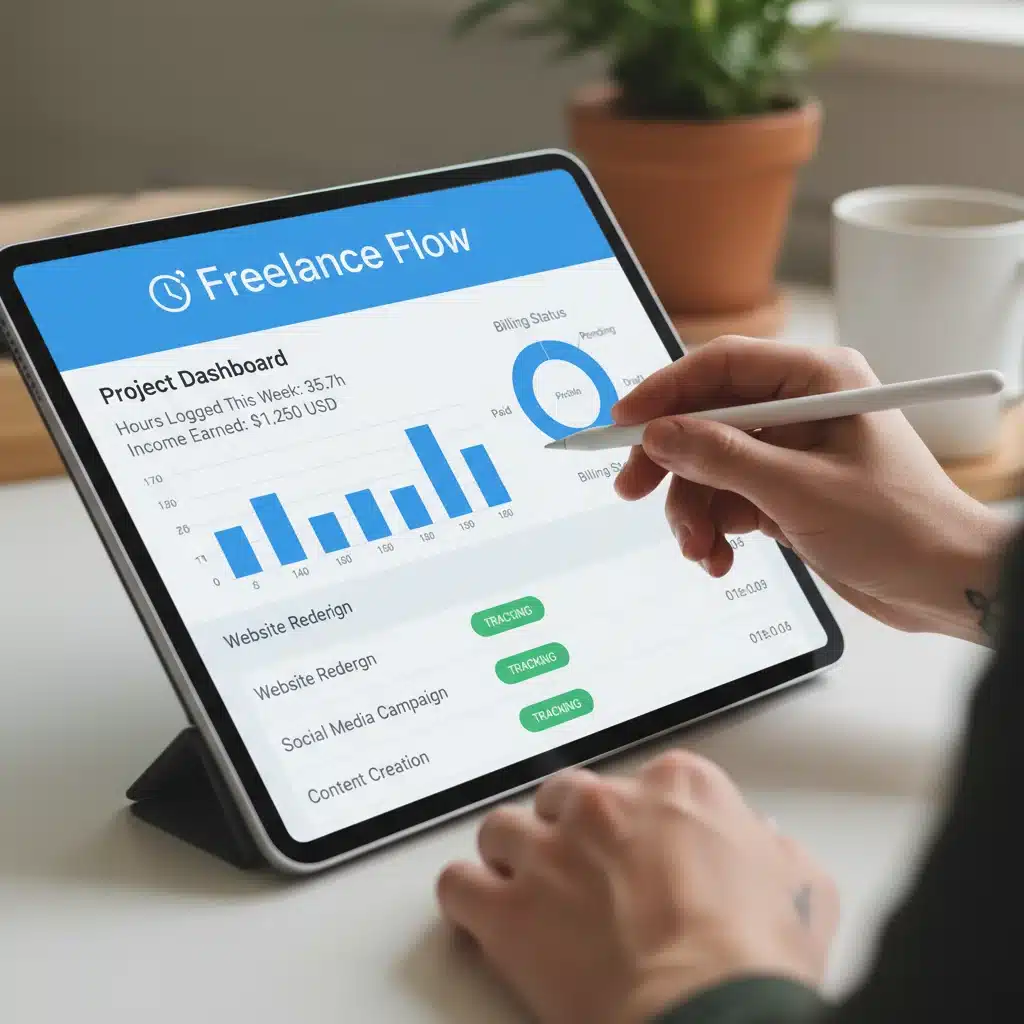
5. HoneyBook: All-in-One for Creative Professionals
While not solely a freelance time tracking tool, HoneyBook has become an indispensable all-in-one platform for creative US freelancers in 2026. It integrates time tracking seamlessly within its broader suite of features, which includes proposals, contracts, invoicing, and client communication. For freelancers who want to manage their entire client lifecycle from one platform, HoneyBook offers unparalleled convenience.
- Pros: Comprehensive client management, professional proposals and contracts, integrated payments, excellent for service-based businesses.
- Cons: Time tracking is part of a larger, more expensive suite; may be overkill if you only need time tracking.
- Best for: Creative freelancers (designers, photographers, coaches) who need a full-service client management system.
6. FreshBooks: Accounting Software with Robust Time Tracking
FreshBooks continues to be a leading accounting software, and its freelance time tracking capabilities are top-notch. For freelancers who want their time tracking directly integrated with their accounting, expense management, and invoicing, FreshBooks is an excellent choice. In 2026, its mobile app has seen significant enhancements, making on-the-go tracking and invoicing even smoother.
- Pros: Strong accounting and invoicing features, intuitive time tracking, excellent mobile app, integrates with many payment gateways.
- Cons: Primarily an accounting tool, so its focus isn’t exclusively on time tracking; pricing can be higher than standalone time trackers.
- Best for: Freelancers who prioritize integrated accounting and invoicing alongside their time tracking.
How to Choose the Right Freelance Time Tracking Tool for You
Selecting the best freelance time tracking tool involves more than just picking the most popular option. It requires a thoughtful assessment of your specific needs, workflow, and budget. Here’s a step-by-step approach:
1. Define Your Core Needs
Start by making a list of your absolute must-have features. Do you primarily need a simple timer and basic reports? Or do you require integrated invoicing, expense tracking, and project management? Do you work across multiple devices, or do you need offline capabilities? Knowing your priorities will narrow down your choices significantly.
2. Consider Your Business Type and Scale
Are you a solo freelancer, or do you occasionally collaborate with subcontractors? Do you have a high volume of small projects or fewer, long-term engagements? Tools like HoneyBook might be overkill for someone who only needs basic time tracking, while Toggl Track might not offer enough financial management for a freelancer scaling into a small agency.
3. Evaluate Your Budget
Many freelance time tracking tools offer free tiers, which are great for getting started. However, as your business grows, you might need premium features. Compare the pricing models (per user, per project, tiered) and what features are included at each level. Remember to factor in the potential return on investment (ROI) – a paid tool that saves you significant time and ensures accurate billing can easily pay for itself.
4. Test Drive with Free Trials
Almost all reputable time-tracking tools offer a free trial or a free tier. Take advantage of these opportunities! Spend a few days or a week using the tool as you would in your daily work. Pay attention to ease of use, the accuracy of tracking, and how well it integrates into your existing workflow.
5. Read Reviews and Get Recommendations
While this guide provides an overview, individual experiences can be valuable. Look at recent reviews from other US freelancers on platforms like Capterra, G2, or Trustpilot. Ask for recommendations in freelance communities or forums. Pay attention to comments about customer support and reliability.
6. Future-Proofing Your Choice
Consider your long-term goals. Will the tool scale with your business? Does it offer features you might need in the future, such as team management, client portals, or advanced analytics? Choosing a tool that can grow with you will save you the hassle of switching platforms down the line.
Maximizing Annual Savings with Your Chosen Tool
Once you’ve selected your ideal freelance time tracking tool, the real work of maximizing your annual savings begins. It’s not enough to just have the tool; you need to leverage its capabilities fully.
1. Consistent Usage
The most crucial step is consistent, diligent usage. Make time tracking a non-negotiable part of your daily routine. Start the timer when you begin work and stop it when you finish or switch tasks. Even short breaks or quick emails should be accurately logged if they are billable or part of your work process.
2. Detailed Project & Task Breakdown
Utilize the project and task categorization features to their fullest. Instead of just logging ‘Client X Project Y,’ break it down into ‘Client X Project Y: Research,’ ‘Client X Project Y: Content Creation,’ ‘Client X Project Y: Revisions.’ This level of detail not only justifies your hours to clients but also provides invaluable data for future project estimations and identifying areas for efficiency improvements.
3. Leverage Automation Features
Many 2026 freelance time tracking tools offer automation. Set up automatic reminders, integrate with your calendar, or use features that detect idle time or automatically suggest task categorization. The less manual input required, the fewer forgotten hours.
4. Integrate with Invoicing & Accounting
If your tool has integrated invoicing, use it! Generating invoices directly from tracked hours eliminates manual data entry, reduces errors, and speeds up the billing process. If it integrates with external accounting software, ensure the connection is active and data flows smoothly. This integration alone can save dozens of hours annually on administrative tasks.
5. Analyze Your Reports Regularly
Don’t just track; analyze. Regularly review your time tracking reports. Look for patterns: Are you spending too much time on non-billable administrative tasks? Are certain projects consistently going over budget? Are there specific clients where you’re consistently under-billing? These insights are gold for optimizing your rates, improving your workflow, and strategically growing your business.
6. Communicate Transparently with Clients
Use your detailed timesheets to build trust with clients. If a project is taking longer than expected, share your time logs to explain why. This transparency can prevent disputes and ensure you’re compensated fairly for all your efforts. Many tools allow you to share reports directly with clients or offer client portals for real-time visibility.

The Financial Impact: How Many Hours and Dollars Can You Save Annually?
The financial impact of implementing an effective freelance time tracking tool can be staggering. Let’s quantify the potential savings for a typical US freelancer:
Preventing Lost Billable Hours
Studies show that freelancers often underestimate their hours by 10-15% when not using a dedicated tracking tool. For a freelancer working 40 hours a week at an average rate of $50/hour, that’s 4-6 hours per week lost. Over a year (50 working weeks), this amounts to 200-300 lost hours. At $50/hour, that’s an annual loss of $10,000 – $15,000! A good time tracker virtually eliminates this loss.
Reducing Administrative Time
Manually creating invoices, calculating hours, and reconciling payments can take several hours per month. If you spend 5 hours a month on these tasks, and your tool automates half of that, you save 30 hours annually. At $50/hour, that’s an additional $1,500 saved or potentially earned by focusing on billable work.
Improved Project Estimations
With historical data from your time tracking, your project estimations become far more accurate. This means fewer projects where you underquote and end up working for free. If just two projects a year are estimated more accurately, saving you 10 hours each, that’s 20 hours of avoided ‘free work,’ translating to $1,000 in saved income.
Faster Payments & Better Cash Flow
Professional, detailed invoices generated quickly by your time tracker often lead to faster client payments. Improved cash flow reduces stress and can prevent the need for short-term loans or credit, saving on interest fees.
Tax Season Efficiency
When tax season arrives, having perfectly organized reports of all your income and expenses, directly linked to your tracked hours, significantly reduces the time and effort involved. If you save just 10 hours on tax preparation or accountant fees (by providing cleaner data), that’s another $500 in value.
Total Estimated Annual Savings
Conservatively, by preventing lost billable hours, reducing admin time, improving estimates, and streamlining financial processes, a US freelancer can realistically expect to save or earn an additional $13,000 to $18,000+ annually by effectively utilizing a top 2026 freelance time tracking tool. This isn’t just about saving money; it’s about valuing your time and maximizing your earning potential.
Conclusion: Invest in Your Time, Invest in Your Future
The world of freelancing in 2026 demands efficiency, accuracy, and smart business practices. A robust freelance time tracking tool is no longer a luxury but a fundamental component of a successful independent career. By carefully evaluating the options, understanding your specific needs, and committing to consistent usage, you can unlock significant annual savings in both time and money.
Whether you opt for the comprehensive power of Harvest, the elegant simplicity of Toggl Track, the generous free features of Clockify, the unique approach of Timeular, the all-in-one client management of HoneyBook, or the integrated accounting of FreshBooks, the key is to choose a tool that empowers you. Make 2026 the year you take absolute control of your billable hours, streamline your operations, and dramatically boost your annual income as a US freelancer. Your time is worth it – track it wisely.