2026 Self-Employment Tax: Calculate, Reduce & Understand Your 15.3% Obligation

Anúncios
Understanding the 2026 Self-Employment Tax: How to Calculate and Reduce Your 15.3% Obligation
Are you self-employed, a freelancer, or a small business owner? If so, the 2026 Self-Employment Tax is a crucial aspect of your financial planning that demands your attention. Unlike traditional employees who have Social Security and Medicare taxes withheld from their paychecks, self-employed individuals are responsible for paying both the employee and employer portions of these taxes. This often comes as a surprise to new entrepreneurs and can significantly impact your net income if not properly managed. This comprehensive guide will demystify the 2026 Self-Employment Tax, explain its components, walk you through the calculation process, and, most importantly, provide actionable strategies to reduce your 15.3% obligation.
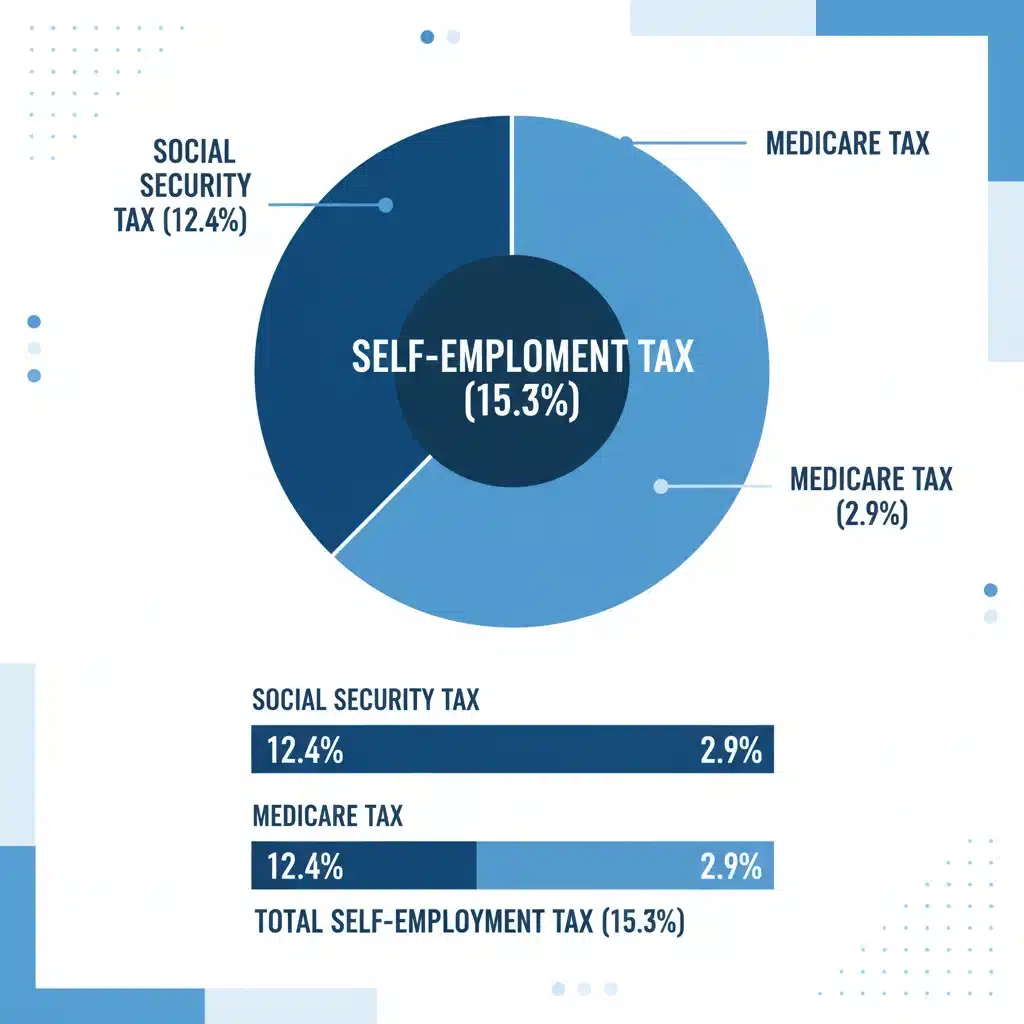
The world of self-employment offers immense freedom and potential, but it also comes with unique tax responsibilities. For 2026, the self-employment tax rate remains a steady 15.3% on your net earnings from self-employment. This rate is comprised of two parts: 12.4% for Social Security (up to an annual earnings limit) and 2.9% for Medicare (with no earnings limit). Understanding these components is the first step toward effective tax planning and ensuring you don’t face unexpected tax bills. Failing to account for this tax can lead to cash flow issues, penalties, and a general sense of financial stress. Therefore, proactive planning for the 2026 Self-Employment Tax is not just recommended; it’s essential for the financial health of your business.
Anúncios
What is the 2026 Self-Employment Tax?
The 2026 Self-Employment Tax (SE tax) is essentially a combination of Social Security and Medicare taxes primarily for individuals who work for themselves. When you’re self-employed, you’re both the employer and the employee. This means you’re responsible for paying both halves of these taxes, which in an employer-employee relationship would be split. The total rate is 15.3% on your net earnings from self-employment. This includes income from freelance work, independent contracting, gig economy jobs, and owning an unincorporated business.
Breaking Down the 15.3% Rate:
- Social Security Tax: This portion is 12.4% of your net earnings from self-employment, up to an annual earnings limit. For 2026, while the exact limit will be announced later, it typically increases each year. For context, in recent years, this limit has been around $160,200 (for 2023) and $168,600 (for 2024). Earnings above this threshold are not subject to the Social Security portion of the tax.
- Medicare Tax: This portion is 2.9% of your net earnings from self-employment, and there is no earnings limit. This means all of your net self-employment income is subject to the Medicare tax.
It’s important to note that the self-employment tax is separate from your income tax. You’ll pay both. However, there’s a significant deduction available: you can deduct one-half of your self-employment tax when calculating your adjusted gross income (AGI). This deduction helps to offset the burden of paying both halves of the Social Security and Medicare taxes. Understanding this deduction is a key part of managing your 2026 Self-Employment Tax effectively.
Anúncios
Who Pays the 2026 Self-Employment Tax?
If you are a self-employed individual and your net earnings from self-employment are $400 or more, you are generally subject to the 2026 Self-Employment Tax. This applies to a wide range of professionals, including:
- Freelancers and independent contractors
- Gig economy workers (e.g., rideshare drivers, delivery services, online content creators)
- Small business owners operating as sole proprietors
- Partners in a partnership (general partners and, in some cases, limited partners)
- Members of a multi-member LLC treated as a partnership
- Individuals who receive income reported on Form 1099-NEC or 1099-MISC for services rendered
Even if you have a full-time job where Social Security and Medicare taxes are withheld, any additional income you earn through self-employment that meets the $400 threshold will be subject to the 2026 Self-Employment Tax. It’s crucial not to overlook this, as many individuals mistakenly believe their W-2 job covers all their tax obligations.
How to Calculate Your 2026 Self-Employment Tax
Calculating your 2026 Self-Employment Tax involves a few steps. The IRS provides Schedule SE (Form 1040), Self-Employment Tax, to help you with this calculation. Here’s a simplified breakdown:
Step 1: Determine Your Net Earnings from Self-Employment
This is the starting point. Your net earnings are your gross income from your trade or business minus your allowable business expenses. It’s crucial to keep meticulous records of all your income and expenses throughout the year. If you have multiple self-employment activities, you combine the income and expenses from all of them.
Example: If your gross income from freelancing is $60,000 and your legitimate business expenses (home office, supplies, software, travel, etc.) are $10,000, your net earnings would be $50,000.
Step 2: Calculate the Net Earnings Subject to SE Tax
The IRS allows you to multiply your net earnings from self-employment by 92.35% (or 0.9235). This adjustment accounts for the deduction of one-half of your self-employment tax when computing your adjusted gross income. It effectively reduces the amount of income subject to the SE tax.
Formula: Net Earnings Subject to SE Tax = Net Earnings from Self-Employment × 0.9235
Using the example: $50,000 × 0.9235 = $46,175
Step 3: Calculate the Social Security Portion
Multiply the amount from Step 2 by 12.4%. Remember, this is subject to the annual earnings limit. For the purpose of this example, let’s assume the 2026 Social Security earnings limit is $175,000 (hypothetical for illustration).
Formula: Social Security Tax = (Net Earnings Subject to SE Tax, up to limit) × 0.124
Using the example: Since $46,175 is below the hypothetical $175,000 limit, the Social Security tax would be $46,175 × 0.124 = $5,725.70.
Step 4: Calculate the Medicare Portion
Multiply the amount from Step 2 by 2.9%. There is no earnings limit for Medicare tax.
Formula: Medicare Tax = Net Earnings Subject to SE Tax × 0.029
Using the example: $46,175 × 0.029 = $1,339.08.
Step 5: Total Your 2026 Self-Employment Tax
Add the Social Security tax from Step 3 and the Medicare tax from Step 4.
Formula: Total SE Tax = Social Security Tax + Medicare Tax
Using the example: $5,725.70 + $1,339.08 = $7,064.78.
This $7,064.78 is your total 2026 Self-Employment Tax obligation. This amount will be reported on Schedule SE and then transferred to your Form 1040.
Estimated Taxes and Your 2026 Self-Employment Tax
Since self-employed individuals don’t have taxes withheld from each payment, you are generally required to pay estimated taxes throughout the year. This includes both your income tax and your 2026 Self-Employment Tax. Estimated taxes are typically paid in four equal installments, due on April 15, June 15, September 15, and January 15 of the following year. If you don’t pay enough tax through withholding and estimated payments, you could face a penalty for underpayment of estimated tax.
To avoid penalties, you generally need to pay at least 90% of your current year’s tax liability or 100% of your previous year’s tax liability (110% if your AGI was over $150,000). It’s wise to consult with a tax professional or use tax software to help calculate your estimated payments accurately.
Strategies to Reduce Your 2026 Self-Employment Tax
While the 15.3% rate for the 2026 Self-Employment Tax is fixed, there are several legitimate strategies you can employ to reduce your overall tax burden. These primarily focus on reducing your net earnings from self-employment, which is the base for the tax calculation.
1. Maximize Business Expense Deductions
This is arguably the most straightforward and impactful way to reduce your 2026 Self-Employment Tax. Every dollar of legitimate business expense reduces your net earnings, and thus the amount subject to SE tax. Keep meticulous records of all your expenses. Common deductions include:
- Home Office Deduction: If you use a portion of your home exclusively and regularly for business, you may qualify for this deduction. You can use the simplified method ($5 per square foot, up to 300 square feet) or the regular method (actual expenses).
- Business Travel and Meals: Expenses for business-related travel (airfare, lodging, car rental) are deductible. Business meals are generally 50% deductible.
- Office Supplies and Equipment: Pens, paper, computers, printers, software subscriptions, and other necessary tools for your business.
- Professional Development: Costs for courses, conferences, books, and subscriptions related to improving your business skills.
- Insurance Premiums: Business liability insurance, professional malpractice insurance, and even health insurance premiums (if you’re self-employed and not eligible for an employer-sponsored plan) can be deductible.
- Legal and Professional Fees: Payments to accountants, lawyers, and other consultants for business advice.
- Advertising and Marketing: Website costs, online ads, business cards, and other promotional expenses.
- Vehicle Expenses: If you use your car for business, you can deduct actual expenses (gas, oil, repairs, insurance) or use the standard mileage rate.
Pro-Tip: Don’t just track large expenses. Small, recurring expenses add up quickly. Use accounting software or a spreadsheet to categorize and track everything.
2. Contribute to Self-Employed Retirement Plans
Contributing to a qualified retirement plan is a powerful way to reduce your taxable income, including the income subject to 2026 Self-Employment Tax. These contributions are often tax-deductible, meaning they reduce your net earnings from self-employment before the SE tax is calculated. Popular options for the self-employed include:
- SEP IRA (Simplified Employee Pension IRA): Easy to set up and administer, allowing you to contribute a significant portion of your net earnings.
- Solo 401(k): Offers higher contribution limits than a SEP IRA, allowing you to contribute as both the employee and the employer.
- SIMPLE IRA (Savings Incentive Match Plan for Employees IRA): Suitable for small businesses with up to 100 employees, including the owner.
The earlier you start contributing, the more you can save on taxes and build a substantial retirement nest egg. Consult with a financial advisor to determine which plan is best for your specific situation.
3. Deduct One-Half of Your Self-Employment Tax
As mentioned earlier, you can deduct one-half of your 2026 Self-Employment Tax from your gross income when calculating your adjusted gross income (AGI). This isn’t a deduction from the self-employment tax itself, but it reduces your overall income tax liability. While this doesn’t directly reduce the 15.3% SE tax rate, it’s a significant benefit that helps to mitigate the impact of paying both employer and employee portions.
4. Consider Your Business Structure
For many sole proprietors, changing their business structure can offer tax advantages, particularly concerning the 2026 Self-Employment Tax. While sole proprietorships and single-member LLCs (taxed as sole proprietorships) pay SE tax on all net earnings, electing S-Corp status can change this.
- S-Corporation Election: If you elect for your business to be taxed as an S-Corporation, you can pay yourself a reasonable salary (which is subject to Social Security and Medicare taxes, just like a W-2 employee). Any remaining profits can then be distributed to you as dividends, which are generally not subject to self-employment tax. This strategy can lead to significant SE tax savings, especially for highly profitable businesses. However, it comes with increased administrative complexity and costs, so it’s essential to weigh the pros and cons carefully with a tax professional.
This strategy is typically more beneficial for businesses with substantial profits after paying a reasonable salary.

5. Health Savings Accounts (HSAs)
If you have a high-deductible health plan (HDHP), contributing to a Health Savings Account (HSA) can be a triple tax benefit: contributions are tax-deductible (reducing your taxable income), earnings grow tax-free, and withdrawals for qualified medical expenses are tax-free. For the self-employed, the tax deduction for HSA contributions directly reduces your adjusted gross income, indirectly impacting your overall tax picture, including the base for the 2026 Self-Employment Tax.
6. Keep Accurate Records and Use Accounting Software
The foundation of all tax-saving strategies is meticulous record-keeping. Without proper documentation, you can’t claim deductions or justify your income and expenses to the IRS. Investing in good accounting software (like QuickBooks Self-Employed, FreshBooks, or Xero) can automate much of this process, making it easier to track income, categorize expenses, and generate reports for tax time. This not only helps you maximize deductions but also ensures you’re prepared for any IRS inquiries regarding your 2026 Self-Employment Tax.
Common Mistakes to Avoid with the 2026 Self-Employment Tax
Navigating self-employment taxes can be tricky, and several common pitfalls can lead to unnecessary stress or penalties. Be aware of these to ensure smooth sailing with your 2026 Self-Employment Tax obligations:
- Not Paying Estimated Taxes: One of the biggest mistakes. The IRS expects you to pay taxes as you earn income. Failing to make quarterly estimated payments can result in penalties, even if you pay all your taxes by the April deadline.
- Underestimating Income: It’s better to overestimate your income slightly for estimated tax purposes than to underestimate it. You can always adjust later, but underpaying can lead to penalties.
- Missing Deductions: Every missed deduction is money left on the table. Keep thorough records and review all potential business expenses. Many self-employed individuals overlook legitimate deductions, unnecessarily increasing their 2026 Self-Employment Tax.
- Confusing Business and Personal Expenses: Commingling funds or failing to properly separate business and personal expenses can complicate record-keeping and raise red flags during an audit.
- Ignoring the Social Security Earnings Limit: If you also have W-2 income, be mindful of the Social Security earnings limit. If your combined W-2 wages and self-employment income exceed this limit, you might overpay Social Security tax. The IRS will reconcile this, but it’s good to be aware.
- Not Consulting a Tax Professional: While this guide provides valuable information, a qualified tax professional can offer personalized advice, identify unique deductions for your industry, and help you navigate complex situations, especially if you’re considering an S-Corp election.
The Importance of Proactive Tax Planning for the 2026 Self-Employment Tax
Effective tax planning is not a once-a-year event; it’s an ongoing process. For the self-employed, this means regularly reviewing your income and expenses, adjusting your estimated tax payments as needed, and staying informed about tax law changes. The 2026 Self-Employment Tax, while seemingly straightforward at 15.3%, has nuances that can significantly impact your financial well-being.
By understanding how the tax is calculated, diligently tracking your business expenses, exploring retirement savings options, and considering your business structure, you can proactively manage your tax burden. This approach not only ensures compliance with IRS regulations but also frees up more capital for your business growth and personal financial goals.
Conclusion
The 2026 Self-Employment Tax is an unavoidable reality for anyone working for themselves. At 15.3% of your net earnings from self-employment, it represents a substantial financial obligation. However, by understanding its components, accurately calculating your liability, and implementing smart tax planning strategies, you can effectively manage and even reduce this burden.
Remember to keep excellent records, maximize your legitimate business deductions, contribute to self-employed retirement plans, and consider the benefits of an S-Corp election if appropriate for your business. Don’t let the complexities of self-employment tax deter you from pursuing your entrepreneurial dreams. With the right knowledge and proactive planning, you can navigate your tax responsibilities with confidence and keep more of your hard-earned money.
Start planning now for your 2026 Self-Employment Tax to ensure a financially stable and successful year.