Master Your Remote Work: Eliminate Distractions for 2026 Success

Anúncios
Master Your Remote Work: Eliminate Distractions for 2026 Success
The landscape of work has fundamentally shifted, with remote work becoming a cornerstone of modern professional life. While it offers unparalleled flexibility and autonomy, it also presents a unique challenge: the omnipresence of distractions. From the allure of social media notifications to the demands of household chores, our home environments are fertile ground for productivity killers. As we look towards 2026, the ability to cultivate a hyper-focused remote workspace isn’t just a desirable trait; it’s a critical skill for success. This comprehensive guide will equip you with the strategies to achieve significant remote work distraction elimination, aiming to reduce them by a remarkable 70%.
Imagine a workday where your focus remains unbroken, where tasks are completed with efficiency and precision, and where you leave your desk feeling accomplished rather than drained. This isn’t a pipe dream; it’s an achievable reality when you strategically address the sources of distraction. We’ll delve into environmental adjustments, digital discipline, psychological strategies, and the power of routines to help you reclaim your concentration and elevate your remote work performance.
Anúncios
The Remote Work Paradox: Freedom vs. Focus
Remote work promises freedom – the freedom to set your own hours, avoid commutes, and work from anywhere. However, this freedom often comes with a hidden cost: a constant battle against distractions. Unlike a traditional office setting, where external structures often enforce focus, your home environment is a tapestry of personal life, entertainment, and responsibilities. The line between work and leisure blurs, making it incredibly easy to drift off course.
Studies consistently show that distractions significantly impact productivity. A brief interruption, even just a few seconds, can take up to 20 minutes to recover from fully. Multiply that by dozens of daily interruptions, and you begin to understand the cumulative toll on your output and mental energy. For 2026, the goal isn’t just to manage distractions; it’s to master remote work distraction elimination to create an environment where deep work thrives.
Anúncios
Identifying Your Personal Distraction Profile
Before you can eliminate distractions, you need to know what they are. Distractions fall into several categories:
- External Distractions: These are environmental factors like noise (traffic, family, pets), interruptions from housemates, phone calls, or even the weather outside your window.
- Digital Distractions: The siren song of social media, email notifications, instant messages, endless browsing, and the temptation of streaming services.
- Internal Distractions: These originate within you – wandering thoughts, anxiety, hunger, fatigue, procrastination, or the urge to do something else.
- Physical Distractions: An uncomfortable chair, poor lighting, a messy workspace, or even an unoptimized computer setup.
Take a moment to honestly assess which of these categories most frequently derail your focus. Keeping a distraction log for a day or two can provide invaluable insights into your unique patterns. Understanding your personal distraction profile is the first crucial step toward effective remote work distraction elimination.
Phase 1: Environmental Engineering for Focus
Your physical environment plays a monumental role in your ability to concentrate. A well-designed workspace acts as a silent guardian against interruptions, signaling to your brain that it’s time to work. The goal here is to create a sanctuary of productivity.
Dedicated Workspace: The Foundation of Focus
The single most impactful step you can take is to establish a dedicated workspace. This doesn’t necessarily mean a separate room, but it should be a designated area solely for work. This spatial separation helps your brain switch into "work mode" when you enter it and "off-duty mode" when you leave. Avoid working from your bed or couch if possible, as these spaces are associated with relaxation, making it harder to focus.
Even if it’s a small corner of a room, make it distinct. Use a room divider, a different lighting setup, or even just a specific chair to mark its boundaries. This physical boundary is a powerful tool for remote work distraction elimination.
Minimize Visual Clutter
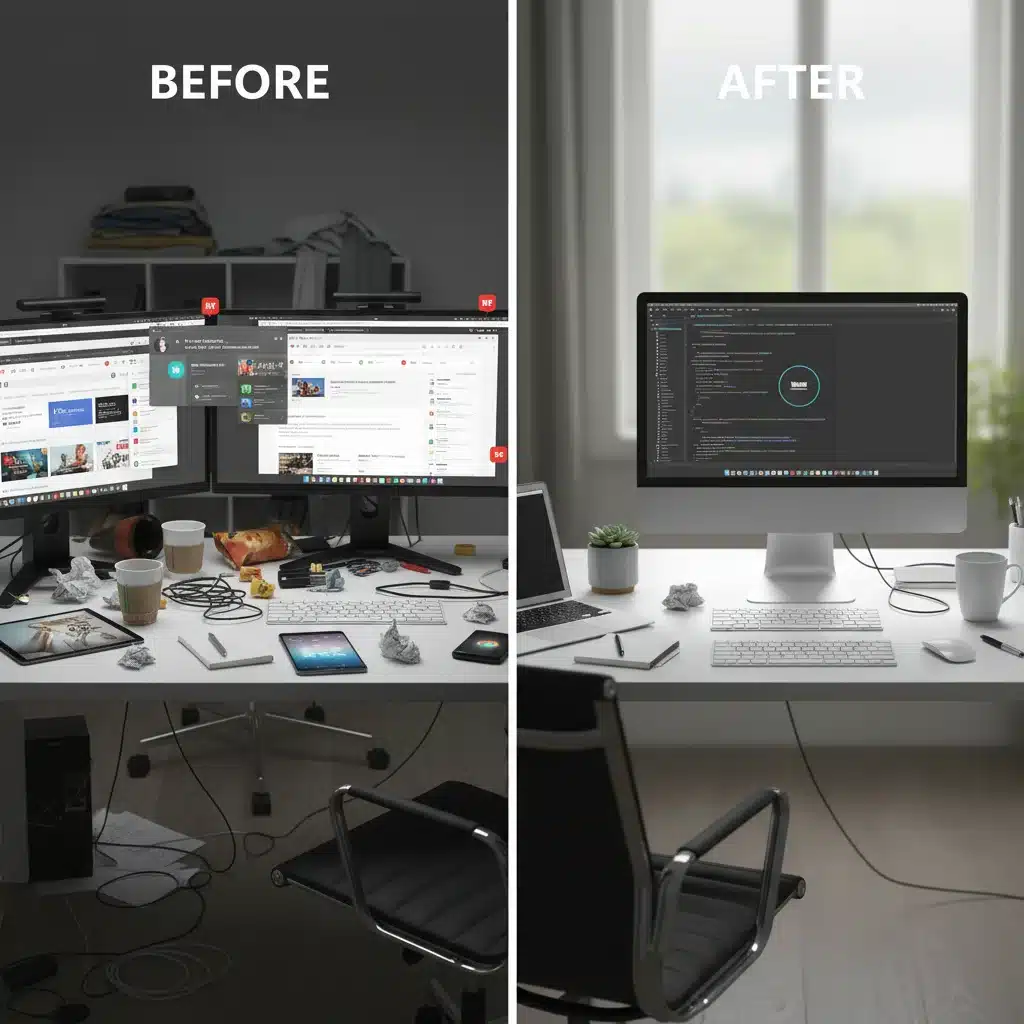
A cluttered desk leads to a cluttered mind. Visual noise constantly vies for your attention, even subconsciously. Adopt a minimalist approach: only keep essential items on your desk. Store files, stationery, and personal items out of sight. A clean, organized surface promotes clarity and reduces the temptation to fidget or get sidetracked by non-work items.
Consider the "one-touch" rule: handle each piece of paper or item only once. Decide immediately if it needs to be filed, acted upon, or discarded. This prevents piles from accumulating and becoming visual distractions.
Sound Management: Silence is Golden (or Customized)
Noise is a primary external distraction. Here’s how to tackle it:
- Noise-Canceling Headphones: An indispensable tool for remote workers. Invest in a good pair to block out ambient noise, whether it’s traffic, family chatter, or construction.
- Ambient Sound: For some, complete silence can be distracting. Experiment with white noise, brown noise, instrumental music, or nature sounds. Tools like Brain.fm or Coffitivity can provide background audio specifically designed for focus.
- Communicate Boundaries: If you live with others, clearly communicate your work hours and the need for uninterrupted focus. Use a "do not disturb" sign on your door.
Optimize Lighting and Ergonomics
Poor lighting can cause eye strain and fatigue, making it harder to concentrate. Natural light is ideal; position your desk near a window if possible. Supplement with good task lighting that doesn’t cause glare. Ergonomics are equally vital. An uncomfortable chair or poorly positioned monitor can lead to physical discomfort, which quickly becomes an internal distraction. Invest in an ergonomic chair, adjust your monitor to eye level, and ensure your keyboard and mouse are comfortably accessible. These adjustments are crucial for sustained focus and long-term well-being, contributing significantly to remote work distraction elimination.
Phase 2: Digital Discipline and Tech Taming
In the digital age, our devices are both our greatest tools and our most formidable foes. Taming digital distractions is paramount for achieving 70% remote work distraction elimination.
Notification Annihilation
Every notification is an interruption, pulling your attention away from your current task. The solution is simple yet powerful: turn them off. All of them. For your phone, put it on silent, turn off vibrate, and place it out of sight (or even in another room) during deep work blocks. For your computer, disable all non-essential desktop notifications from email, social media, news apps, and even messaging platforms unless absolutely critical for your role.
Instead of reacting to every ping, schedule specific times to check emails and messages. This allows you to process communications efficiently without fragmenting your focus throughout the day.
Browser Tab Management: The Open Tab Syndrome
How many tabs do you typically have open? For many, it’s a chaotic mess, each tab a potential rabbit hole. Adopt strict tab management:
- Close Unnecessary Tabs: If it’s not directly related to your current task, close it.
- Tab Management Extensions: Tools like OneTab or Tab Suspender can help you consolidate or temporarily "hibernate" tabs you might need later without losing them.
- Dedicated Browsers/Profiles: Use separate browser profiles or even different browsers for work and personal use. This creates a mental and digital barrier.
Social Media and Entertainment Blockers
The temptation of social media, news sites, and streaming services is immense. Proactive blocking is often more effective than relying on willpower alone. Install website blockers (e.g., Freedom, Cold Turkey, StayFocusd) that can restrict access to distracting sites during your designated work hours. Some even allow you to block entire applications. This is a non-negotiable step for serious remote work distraction elimination.
Email and Communication Strategy
Email can be a constant source of interruption. Implement a strategy:
- Batch Processing: Check and respond to emails at specific intervals (e.g., 9 AM, 1 PM, 4 PM), rather than leaving your inbox open all day.
- "Inbox Zero" Philosophy: Process each email immediately: delete, delegate, respond, or file. Avoid letting emails pile up.
- Clear Communication Guidelines: Set expectations with colleagues about response times. Use synchronous communication (calls/meetings) for urgent matters and asynchronous (email/messaging) for less urgent ones.
Phase 3: Psychological Strategies for Sustained Focus
Beyond the physical and digital, your mindset and habits are crucial for achieving and maintaining focus. These psychological techniques are powerful allies in your quest for remote work distraction elimination.
The Power of Time Blocking and the Pomodoro Technique
Time blocking involves scheduling specific blocks of time for specific tasks. This proactive approach ensures that your most important work gets dedicated attention. Combine this with the Pomodoro Technique: work for 25 minutes, then take a 5-minute break. After four Pomodoros, take a longer 15-30 minute break. This structured approach helps maintain intensity and prevents burnout, training your brain to focus in short, powerful bursts.
Single-Tasking: The Antidote to Multitasking
Multitasking is a myth; what we often do is "task-switching," rapidly moving between different activities. This greatly reduces efficiency and increases errors. Commit to single-tasking: focus on one task, and one task only, until it’s complete or you reach a designated stopping point. This deep focus is where true productivity lies and is central to remote work distraction elimination.
Mindfulness and Meditation
Internal distractions – racing thoughts, anxiety, boredom – can be just as disruptive as external ones. Incorporating mindfulness or short meditation practices into your daily routine can significantly improve your ability to rein in a wandering mind. Even 5-10 minutes of focused breathing can enhance your concentration and emotional regulation, making you more resilient to internal distractions.
Regular Breaks and Movement
It might seem counterintuitive, but strategic breaks are essential for sustained focus. Our brains aren’t designed for continuous, intense concentration. Stepping away from your screen, stretching, walking around, or even just looking out a window allows your mind to rest and recharge. This prevents mental fatigue and helps you return to your work with renewed vigor, directly aiding in remote work distraction elimination.

Phase 4: Establishing Routines and Accountability
Consistency is key to embedding new habits and making distraction elimination a permanent part of your remote work lifestyle. Routines provide structure, and accountability keeps you on track.
Morning and Evening Routines
A strong start and a clear end to your workday are crucial for mental boundaries and focus. Your morning routine should prepare you for work: exercise, meditation, a healthy breakfast, and reviewing your daily tasks. Avoid checking emails or social media immediately upon waking.
Your evening routine should signal the end of work: a "shutdown ritual" where you review what was accomplished, plan for the next day, and then physically or mentally leave your workspace. This prevents work from bleeding into your personal time and helps you start fresh the next day, reducing the carryover of mental clutter that can cause internal distractions.
Setting Clear Goals and Prioritization
When you know exactly what you need to achieve, it’s easier to stay focused and resist distractions. Before each workday, identify your top 1-3 most important tasks (MITs). Use frameworks like the Eisenhower Matrix (Urgent/Important) or the "Eat the Frog" method (tackling the hardest task first) to prioritize. Clear goals act as a compass, guiding your attention and helping you filter out irrelevant tasks and interruptions. This proactive approach is fundamental to effective remote work distraction elimination.
Accountability Partners and Tools
Sometimes, external motivation helps. Consider an accountability partner – a colleague or friend with whom you share your daily goals. Regular check-ins can provide encouragement and a sense of commitment. Additionally, use productivity tracking tools (e.g., Todoist, Asana, Trello) to keep tabs on your progress and stay organized. Seeing your accomplishments can be a powerful motivator.
The "Do Not Disturb" Pact (with Yourself and Others)
Formalize your distraction-free periods. If you have a family, establish a "do not disturb" time when you need absolute focus. For digital communication, use your status messages (e.g., "Focus Time," "In a deep work session") to signal to colleagues when you’re unavailable. Crucially, honor this pact yourself – resist the urge to check that "just one quick thing" during your designated focus blocks.
Measuring Your Progress in Remote Work Distraction Elimination
How do you know if your efforts are paying off? Tracking your progress is essential. Consider:
- Focus Timers/Apps: Many apps can track how long you spend on specific tasks or how many distraction-free minutes you accumulate.
- Productivity Metrics: Are you completing more tasks? Are you feeling less overwhelmed?
- Self-Reflection: At the end of each day or week, take time to reflect on what worked well and what areas still need improvement. Adjust your strategies accordingly.
The goal isn’t necessarily 100% distraction elimination – that’s often unrealistic. The target of 70% remote work distraction elimination is ambitious yet achievable, and it will profoundly impact your productivity, well-being, and overall success in 2026 and beyond.
The Long-Term Benefits of a Hyper-Focused Remote Workspace
Implementing these strategies goes beyond just getting more done. The benefits ripple across your professional and personal life:
- Increased Quality of Work: Deep focus leads to higher quality output, fewer errors, and more innovative solutions.
- Reduced Stress and Burnout: When you’re in control of your attention, you feel less overwhelmed and more capable. The constant context-switching associated with distractions is a major source of mental fatigue.
- Improved Work-Life Balance: By being more efficient during work hours, you can truly disconnect afterward, leading to more fulfilling personal time. You’ll avoid the guilt of unfinished tasks lingering in your mind.
- Enhanced Career Growth: High-quality, focused work is noticed. You’ll build a reputation for reliability and excellence, opening doors to new opportunities.
- Greater Job Satisfaction: Feeling productive and accomplished is incredibly rewarding. A hyper-focused environment fosters a sense of mastery and satisfaction in your work.
Embracing remote work distraction elimination is an investment in yourself and your future. It’s about taking control of your environment, your tools, and your mind to unlock your full potential.
Conclusion: Your Path to a Distraction-Free 2026
As we navigate the evolving world of remote work, the ability to cultivate a hyper-focused environment is no longer a luxury but a necessity. By systematically addressing environmental, digital, and psychological sources of distraction, you can achieve a significant reduction in interruptions – aiming for that transformative 70% mark. From creating a dedicated workspace and annihilating notifications to practicing single-tasking and establishing robust routines, each step contributes to building an impenetrable fortress of focus.
The journey to effective remote work distraction elimination is continuous. It requires self-awareness, discipline, and a willingness to adapt. Start small, implement one or two strategies at a time, and build momentum. The rewards – enhanced productivity, reduced stress, and a profound sense of accomplishment – will undoubtedly propel you toward unparalleled success in 2026 and for years to come. Take charge of your focus, and take charge of your future.