Power Your Travels: Essential Portable Charging Solutions for Digital Nomads
Anúncios
Power Your Travels: Essential Portable Charging Solutions for Digital Nomads
In the dynamic world of digital nomadism, where your office can be a beach in Bali, a co-working space in Berlin, or a mountain cabin in Colorado, one universal truth remains: power is paramount. The freedom to work from anywhere is exhilarating, but it comes with the inherent challenge of maintaining a consistent and reliable power supply for all your essential gadgets. Imagine being on a critical video call, only for your laptop to die, or losing precious work because your tablet ran out of juice in the middle of a creative flow. These scenarios are not just inconvenient; they can be detrimental to your productivity and professional reputation. This is precisely why investing in robust portable charging solutions is not just a luxury, but a fundamental necessity for any successful digital nomad.
The landscape of portable power has evolved dramatically, offering a diverse array of devices designed to keep you charged and connected, regardless of your location. From high-capacity power banks that can revive multiple devices to innovative solar chargers harnessing the sun’s energy, and compact, powerful laptop chargers, the options are plentiful. But with so many choices, how do you determine which portable charging solutions are truly essential for your unique nomadic lifestyle? This comprehensive guide will delve into the critical aspects of powering your remote workspace on the go, exploring the best tools and strategies to ensure you’re always ready to tackle your tasks, capture your experiences, and stay connected with the world.
Anúncios
We’ll examine the different types of portable chargers, their advantages and disadvantages, and what to look for when making your purchase decisions. We’ll also touch upon the importance of understanding your power needs, the role of international adapters, and how to create a resilient charging ecosystem that supports your wanderlust. By the end of this article, you’ll be equipped with the knowledge to make informed choices, transforming potential power anxieties into a seamless, always-on experience. Let’s dive into the world of uninterrupted power for the modern digital nomad.
Understanding Your Power Needs: The Foundation of Effective Portable Charging Solutions
Before you even begin to explore the myriad of portable charging solutions available, the first crucial step is to accurately assess your personal power consumption. This isn’t just about knowing what devices you carry; it’s about understanding how often you use them, for how long, and what their individual power requirements are. A detailed assessment will prevent you from overspending on unnecessary capacity or, worse, being underprepared when you need power the most. Think about your typical workday: how many hours are you actively using your laptop? Do you rely heavily on your smartphone for communication and navigation? Are there other power-hungry devices like cameras, tablets, or even portable monitors that are integral to your workflow?
Start by listing every electronic device you carry. For each device, identify its battery capacity (usually measured in milliampere-hours, mAh, for smaller devices, or watt-hours, Wh, for laptops) and its typical power draw. Researching these specifications will give you a baseline understanding. For instance, a typical smartphone might have a 3,000-5,000 mAh battery, while a laptop could range from 50Wh to 100Wh or more. Knowing these figures will directly influence the capacity of the power banks and chargers you’ll need.
Anúncios
Consider your usage patterns. If you’re often in places with unreliable power grids or spend extended periods off-grid, your need for robust portable charging solutions will be significantly higher than someone who primarily works from co-working spaces with readily available outlets. Factor in travel days, long flights, and outdoor excursions where access to wall sockets might be nonexistent. A good rule of thumb is to aim for enough portable power to get you through at least one full day, ideally two, without external grid access. This buffer provides peace of mind and ensures continuous productivity.
Finally, don’t forget the cables! Having the right cables for each device, and extra backups, is just as important as the power source itself. USB-C is becoming the universal standard, but many older devices still rely on USB-A, Micro-USB, or proprietary connectors. A well-organized cable pouch with durable, fast-charging cables is an often-overlooked but vital component of any effective portable charging setup. By meticulously evaluating your power needs, you lay the groundwork for building a truly effective and reliable charging ecosystem.
High-Capacity Power Banks: The Unsung Heroes of Digital Nomad Productivity
When it comes to essential portable charging solutions, high-capacity power banks undoubtedly sit at the top of the list. These portable batteries are the workhorses of any digital nomad’s arsenal, offering the ability to recharge multiple devices multiple times over, often without needing a wall outlet for days. The market for power banks is vast, but for nomads, focusing on capacity, output ports, and charging speed is paramount.
Capacity Matters: For most digital nomads, a power bank with a capacity of at least 20,000 mAh is a good starting point. This typically provides enough juice for 4-6 full smartphone charges or 1-2 laptop charges. If you have a power-hungry laptop or multiple devices, consider stepping up to 26,800 mAh (the maximum allowed on most flights in carry-on luggage without special airline approval) or even larger capacities if you don’t fly frequently. Remember that listed capacity can sometimes be misleading; always check the actual output efficiency, as some energy is lost during conversion.
Output Ports and Technology: Modern power banks come equipped with various output ports. Look for models with at least one USB-C Power Delivery (PD) port. USB-C PD is crucial for fast-charging laptops, tablets, and even newer smartphones, significantly reducing charging times. Multiple USB-A ports (preferably with Quick Charge technology) are also beneficial for older devices or simultaneous charging. The ability to charge several devices at once is a game-changer when you’re managing a busy remote workspace.
Input Charging Speed: While output is important, don’t overlook input charging speed. A power bank that takes 12 hours to recharge itself is not practical. Look for power banks that support fast input charging via USB-C PD, allowing you to replenish their reserves quickly when you do find an outlet. Some advanced models even feature pass-through charging, meaning they can charge your devices while being recharged themselves, acting as a temporary power hub.
Durability and Portability: As a digital nomad, your gear will face various environments. Choose power banks made from durable materials that can withstand bumps and drops. While capacity is key, the physical size and weight also matter. Balance the need for ample power with the ease of carrying it in your backpack. Brands like Anker, RAVPower, and Jackery are highly regarded for their reliability and performance in the portable power sector. Investing in a high-quality, high-capacity power bank is one of the most effective ways to ensure your portable charging solutions are always ready for action.
The Versatility of Universal Laptop Chargers and Adapters
Beyond power banks, a universal laptop charger is another indispensable component of effective portable charging solutions. While most laptops come with their own dedicated chargers, these are often bulky, heavy, and specific to one brand or model. For a digital nomad who might switch laptops, assist fellow travelers, or simply wants a more streamlined setup, a universal charger offers unparalleled flexibility.
USB-C Power Delivery (PD) Laptop Chargers: The advent of USB-C PD has revolutionized laptop charging. Many modern laptops, from MacBooks to various Windows ultrabooks, can now be charged via a USB-C port. This means a single, compact USB-C PD charger can power your laptop, tablet, and smartphone, significantly reducing the number of bricks and cables you need to carry. Look for chargers with at least 60W output for most ultrabooks, and 90-100W for more powerful laptops. GaN (Gallium Nitride) technology has allowed manufacturers to create incredibly small and efficient high-wattage chargers, making them perfect for travel.
Multi-Port Chargers: To further consolidate your charging setup, consider multi-port USB-C PD chargers. These often feature one or two high-wattage USB-C PD ports alongside several standard USB-A ports. This allows you to charge your laptop, phone, and perhaps a smartwatch or headphones all from a single wall outlet, minimizing the need for multiple adapters and reducing clutter in your workspace. Brands like Anker, Satechi, and UGREEN offer excellent multi-port GaN chargers that are compact yet powerful.
Universal AC Adapters with Interchangeable Tips: For older laptops or those without USB-C charging, a universal AC adapter with interchangeable tips is an excellent backup or primary charger. These chargers come with a variety of connectors that fit different laptop brands and models. While less common now with the rise of USB-C, they still serve a vital purpose for legacy devices or as a versatile option for emergencies. Ensure the adapter delivers the correct voltage and wattage for your specific laptop to avoid damage.
International Travel Adapters: Your portable charging solutions are only as good as your ability to plug them in. A high-quality international travel adapter is non-negotiable. Look for a universal adapter that covers the major plug types (Type A/B, C/E/F, G, I, J, L, M) and ideally includes built-in USB ports for direct charging of smaller devices. Some advanced travel adapters even integrate surge protection, which is invaluable in places with unstable power grids. Don’t skimp on this item; a cheap adapter can fail or, worse, damage your devices. By carefully selecting your laptop chargers and adapters, you ensure that you can power up your primary work tool efficiently and safely, wherever your journey takes you.
Harnessing Nature: Solar Chargers and Portable Generators for Off-Grid Adventures
For the truly adventurous digital nomad who frequently ventures off the beaten path, or those who prioritize sustainable living, traditional wall outlets simply won’t cut it. This is where alternative portable charging solutions like solar chargers and portable power stations come into their own, offering independence from conventional power grids.
Portable Solar Chargers: Solar chargers leverage the sun’s energy to replenish your devices. These come in various forms, from small, foldable panels designed to charge smartphones and power banks directly, to larger, more robust panels that can power laptops or even portable generators. When choosing a solar charger, consider its wattage, efficiency, and portability. Higher wattage means faster charging, but also typically larger panels. Monocrystalline panels are generally more efficient than polycrystalline ones. Look for panels with built-in USB-A and USB-C ports, and ideally, an output compatible with your power bank for storing energy for later use.
While solar chargers are fantastic for sustainability and off-grid use, they do have limitations. Their effectiveness depends entirely on sunlight, meaning cloudy days or nighttime renders them useless. They are also generally slower than wall charging. However, as a supplementary charging method, especially for topping off power banks during the day, they are invaluable for extended outdoor stays. Brands like Goal Zero, Anker, and Jackery offer reliable portable solar panel options.
Portable Power Stations (Portable Generators): For serious power needs, especially when you’re truly off-grid for extended periods, a portable power station (often referred to as a solar generator when paired with solar panels) is the ultimate solution. These are essentially very large, high-capacity power banks with multiple output options, including AC wall outlets, DC car ports, and numerous USB ports. They can power everything from laptops and mini-fridges to medical devices. Their capacity is measured in watt-hours (Wh) and can range from a few hundred Wh to several thousand Wh.
Portable power stations are heavier and more expensive than standard power banks, making them unsuitable for light travel. However, for van life, camping, or remote cabin stays, they provide an unparalleled level of power independence. Many can be recharged via solar panels, car chargers, or standard AC outlets, offering versatile input options. Companies like Jackery, Goal Zero, EcoFlow, and Bluetti dominate this market, offering a range of sizes and features to suit different needs. While not for every digital nomad, for those embracing a truly mobile and off-grid lifestyle, these robust portable charging solutions are game-changers.
Smart Accessories and Best Practices for Maximizing Your Charging Ecosystem
Having the right hardware is only half the battle; integrating smart accessories and adopting best practices will truly optimize your portable charging solutions. These often-overlooked elements can significantly enhance efficiency, extend battery life, and provide greater peace of mind while on the road.
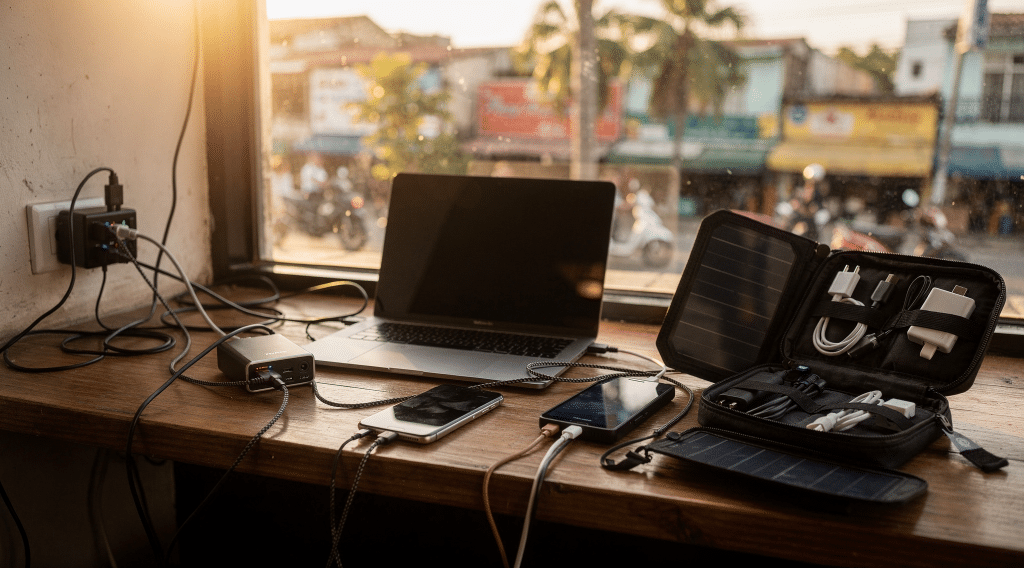
Smart Power Strips and Surge Protectors: When you do find an outlet, especially in older buildings or regions with unreliable power, a portable power strip with surge protection is a wise investment. It allows you to charge multiple devices from a single wall socket while protecting them from voltage spikes. Look for compact travel-friendly versions that also include USB charging ports. This accessory turns a single outlet into a multi-device charging hub, making the most of limited power access.
Cable Management Solutions: A tangled mess of cables is not only frustrating but can also lead to damaged wires and slower charging. Invest in good cable management solutions: reusable cable ties, a dedicated cable organizer pouch, or even magnetic cable clips. Keeping your cables organized ensures they’re always accessible, prevents damage, and maintains a tidy workspace, which is crucial for productivity in small nomadic setups.
Battery Health Monitoring Apps: For your rechargeable devices, especially laptops and smartphones, utilize built-in battery health monitoring features or third-party apps. These tools can give you insights into your battery’s degradation over time, helping you decide when it’s time for a replacement or to adjust your charging habits. Understanding your device’s battery health is key to making informed decisions about your overall portable charging solutions.
Optimizing Device Settings: Extend the life of your device’s charge by optimizing settings. Reduce screen brightness, disable unnecessary background apps, turn off Wi-Fi and Bluetooth when not in use, and enable power-saving modes. For laptops, adjusting power settings to prioritize battery life over performance can significantly stretch your work time between charges. These small adjustments can have a big impact on your overall power consumption.
Regular Maintenance and Updates: Keep your charging devices and accessories clean and updated. Dust and debris can accumulate in ports, affecting charging efficiency. Ensure your power banks and portable generators are regularly charged and discharged (not fully, but cycled to maintain battery health) according to manufacturer recommendations. Firmware updates for smart chargers can also improve performance and compatibility.
Backup and Redundancy: Always have a backup plan. This might mean carrying a second, smaller power bank, or having a car charger if you travel by road. Redundancy in your vital portable charging solutions means that a single point of failure won’t bring your entire operation to a halt. For instance, if your primary laptop charger fails, having a universal USB-C PD charger as a backup can save the day. By implementing these practices, you’ll create a robust and reliable charging ecosystem that supports your digital nomad adventures.
The Future of Portable Power: Trends and Innovations for Digital Nomads
The world of portable charging solutions is constantly evolving, with new technologies and innovations emerging regularly. For digital nomads, staying abreast of these trends can mean even greater efficiency, lighter gear, and enhanced power independence. The future promises even more integrated and intelligent ways to keep our devices charged, making the nomadic lifestyle even more seamless.
Increased GaN Adoption: Gallium Nitride (GaN) technology has already made significant strides in creating smaller, more efficient chargers. Expect to see even wider adoption of GaN across all charging devices, from wall adapters to power banks, leading to even more compact and powerful solutions. This will allow nomads to carry less bulk without sacrificing charging speed or capacity.
Bidirectional Charging and Power Sharing: Devices that can not only receive power but also share it are becoming more common. Imagine a laptop that can charge your phone, or a power bank that can be charged by a solar panel while simultaneously charging your tablet. This bidirectional capability will create more flexible and interconnected charging ecosystems, reducing the number of dedicated chargers needed. Some smartphones already offer reverse wireless charging, hinting at a future where devices are more versatile power sources.
Solid-State Batteries and Graphene Technology: While still largely in the research and development phase, solid-state batteries and graphene-enhanced batteries promise revolutionary advancements. These technologies could lead to batteries with significantly higher energy density (more power in a smaller, lighter package), faster charging times, and greater safety. When these hit the mainstream, they will fundamentally transform the landscape of portable charging solutions, offering unprecedented freedom for digital nomads.
Wireless Charging Everywhere: While wireless charging is common for smartphones, its application for laptops and larger devices is still nascent. However, advancements in long-range and higher-wattage wireless charging could mean a future where you simply place your devices on a mat or even within a certain proximity to a power source, and they charge automatically. This would eliminate the need for cables entirely in many scenarios, simplifying setups and reducing clutter.
Smarter Power Management Systems: Future portable charging devices will likely incorporate more intelligent power management. This could include AI-powered systems that learn your usage patterns and optimize charging schedules, or chargers that dynamically adjust power output based on the device’s needs and available power sources. Such systems would maximize efficiency and extend the overall lifespan of your batteries.
Integrated and Modular Systems: Expect to see more modular and integrated portable charging solutions. This could mean backpack systems with built-in solar panels and power banks, or travel cases that double as charging stations. The goal is to create seamless power delivery that is almost invisible, allowing digital nomads to focus on their work and experiences rather than worrying about battery levels. Embracing these future trends will ensure that digital nomads remain at the forefront of productivity and convenience, no matter where their adventures lead.
Conclusion: Empowering Your Nomadic Journey with Reliable Portable Charging Solutions
The life of a digital nomad is one of freedom, flexibility, and endless possibilities. Yet, this freedom is inextricably linked to the ability to stay powered and connected. As we’ve explored, a well-thought-out strategy for portable charging solutions is not merely a convenience; it is the bedrock upon which a successful and stress-free nomadic career is built. From the bustling cafes of global cities to the serene solitude of remote landscapes, having reliable power ensures that your remote workspace is always operational, your communication lines are open, and your creative flow remains uninterrupted.
We’ve delved into the essentials: understanding your unique power needs, which forms the critical foundation for any charging setup. We’ve highlighted the indispensable role of high-capacity power banks, the versatile utility of universal laptop chargers and adapters, and the liberating potential of solar chargers and portable power stations for off-grid adventures. Furthermore, we’ve emphasized the importance of smart accessories like surge protectors and effective cable management, alongside best practices for optimizing device settings and maintaining battery health. These elements, when combined, create a robust and resilient charging ecosystem tailored to the demands of life on the road.
The continuous innovation in power technology, from GaN chargers to the promise of solid-state batteries and ubiquitous wireless charging, assures us that the future of portable power will only become more efficient, lighter, and more integrated. By staying informed and strategically investing in the right tools, digital nomads can confidently navigate the challenges of power access, transforming potential hurdles into seamless opportunities for productivity and exploration.
Ultimately, the goal is to empower your nomadic journey, allowing you to focus on your work, immerse yourself in new cultures, and embrace the adventures that come with a life unanchored. With the right portable charging solutions in your arsenal, you’re not just carrying gadgets; you’re carrying the power to create, connect, and thrive anywhere in the world. So, charge up, pack smart, and embark on your next adventure with the confidence that your digital life will always stay alive.