Freelance Retirement: SEP IRA vs. Solo 401(k) for US Self-Employed

Anúncios
For US self-employed individuals, understanding the nuances of SEP IRAs and Solo 401(k)s is crucial for optimizing 2025 freelance retirement planning and securing a robust financial future.
Are you a self-employed professional in the US, wondering how to best secure your golden years? Navigating the world of retirement savings can feel daunting, but understanding the core differences between a SEP IRA and a Solo 401(k) is fundamental for freelance retirement planning in 2025. This guide will help you make an informed decision, ensuring your hard-earned money works as hard as you do.
Anúncios
Understanding the Freelance Retirement Landscape in 2025
The year 2025 brings both opportunities and challenges for self-employed individuals looking to save for retirement. With evolving economic landscapes and a growing gig economy, traditional retirement vehicles often fall short of addressing the unique needs of freelancers. This section explores the current environment and why specialized plans are paramount.
Freelancers often face irregular income streams and the absence of employer-sponsored benefits, making proactive retirement planning essential. Unlike traditional employees, self-employed individuals bear the full responsibility for their retirement savings, including choosing the right plan, managing contributions, and understanding tax implications. The flexibility of freelance work, while appealing, necessitates a disciplined approach to financial security.
Anúncios
The unique challenges of self-employment
- Income Volatility: Fluctuating earnings can make consistent contributions difficult without a flexible plan.
- Tax Burden: Self-employment taxes add another layer of complexity to financial planning.
- No Employer Match: Freelancers miss out on the employer contributions common in traditional 401(k)s.
- Healthcare Costs: The need to self-fund health insurance can impact available savings for retirement.
Despite these challenges, the self-employed have powerful tools at their disposal to build substantial retirement nests. The key lies in selecting the right vehicle that aligns with their income, contribution goals, and administrative comfort. The choice between a SEP IRA and a Solo 401(k) often comes down to these personalized factors.
In conclusion, the 2025 freelance retirement landscape demands a strategic approach tailored to the self-employed. Understanding the unique challenges and the specialized retirement options available is the first step toward securing a prosperous future.
SEP IRA: Simplicity and High Contribution Limits
The Simplified Employee Pension Individual Retirement Arrangement, or SEP IRA, is a popular choice for many self-employed individuals and small business owners due to its straightforward nature and generous contribution limits. It’s an excellent option for those seeking a less complex retirement plan with significant savings potential.
A SEP IRA allows employers (including self-employed individuals who are considered their own employer) to contribute to a traditional IRA set up for themselves and their employees. For freelancers, this means you contribute to your own SEP IRA as both the employer and employee. Contribution limits are typically very high, making it attractive for those with substantial self-employment income.
Key features and advantages of a SEP IRA
One of the primary benefits of a SEP IRA is its administrative simplicity. There are no annual filing requirements with the IRS (like Form 5500), which can be a significant time-saver for busy freelancers. Setting up a SEP IRA often involves opening an account with a financial institution and completing a simple adoption agreement.
- High Contribution Limits: In 2025, you can contribute up to 25% of your net self-employment earnings (after deducting one-half of your self-employment tax and SEP contributions), capped at $69,000.
- Easy Setup and Administration: Minimal paperwork and no annual IRS filings make it user-friendly.
- Flexibility in Contributions: You are not required to contribute every year, offering flexibility during periods of fluctuating income.
- Tax-Deductible Contributions: Contributions are tax-deductible, reducing your taxable income in the year they are made.
While the administrative burden is low, it’s important to remember that if you have employees, you must contribute the same percentage of compensation for them as you do for yourself. This can be a significant consideration for freelancers who later expand their operations.
In summary, the SEP IRA offers a compelling blend of high contribution potential and administrative ease, making it an attractive option for many self-employed individuals seeking to optimize their retirement savings.
Solo 401(k): Maximizing Contributions and Loan Options
The Solo 401(k), also known as an Individual 401(k) or Uni-K, often appeals to self-employed individuals who want to maximize their retirement contributions. This plan allows you to contribute in two capacities: as both an employee and an employer, potentially leading to higher overall savings than a SEP IRA, especially for those with significant income.
Unlike a SEP IRA, a Solo 401(k) is a full-fledged 401(k) plan designed for business owners with no employees other than a spouse. This structure allows for both elective deferral contributions (as an employee) and profit-sharing contributions (as an employer), providing a powerful mechanism for accelerating retirement savings.
Understanding Solo 401(k) contribution mechanics
The dual contribution mechanism is where the Solo 401(k) truly shines. As an employee, you can contribute up to $23,000 in 2025, or $30,500 if you’re age 50 or older (catch-up contribution). As an employer, you can contribute up to 25% of your net self-employment earnings. The combined total contributions, including both employee and employer contributions, cannot exceed $69,000 in 2025.
- Higher Contribution Potential: Often allows for greater overall contributions compared to a SEP IRA, especially for high-income earners.
- Employee and Employer Contributions: Offers the unique ability to contribute in two distinct capacities.
- Loan Feature: Some Solo 401(k) plans allow you to borrow from your account, which can be useful in emergencies (with strict rules).
- Roth Option: Many Solo 401(k)s offer a Roth contribution option, allowing for tax-free withdrawals in retirement.
While a Solo 401(k) offers more features, it also comes with slightly more administrative complexity. It typically requires filing an annual Form 5500-EZ once your plan assets reach $250,000. However, for those committed to maximizing their retirement savings, the benefits often outweigh this additional administrative effort.
In conclusion, the Solo 401(k) is a robust option for self-employed individuals aiming for maximum contributions and seeking additional features like loan options and Roth contributions. Its dual contribution structure makes it a powerful tool for aggressive retirement planning.
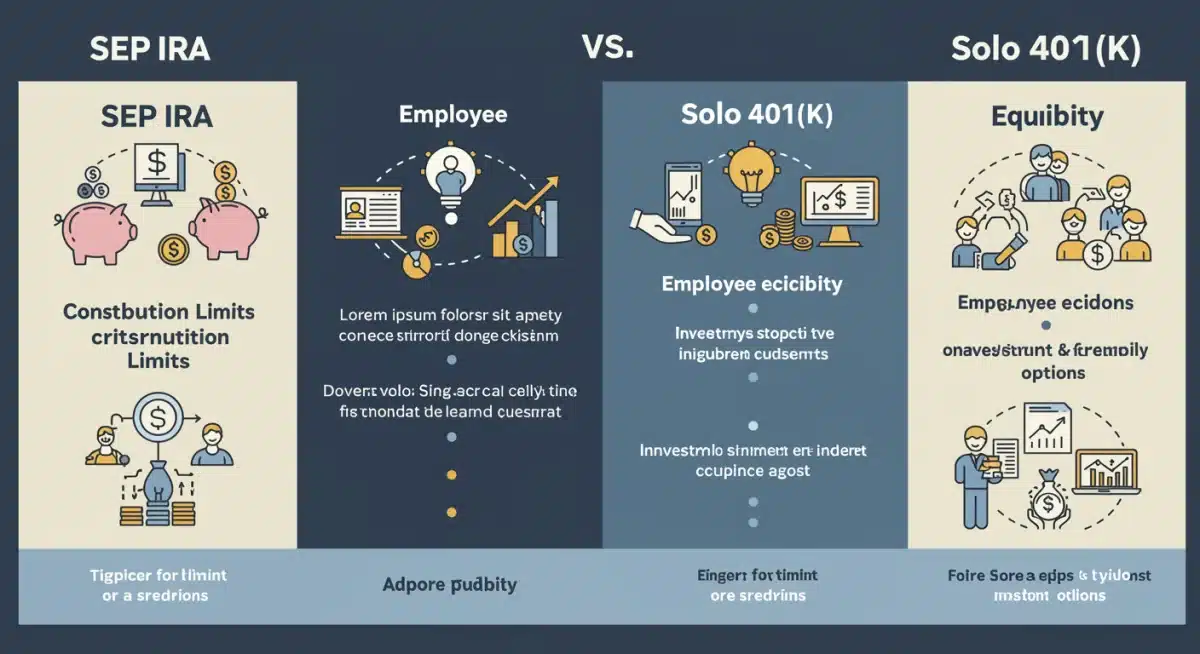
Comparing SEP IRA vs. Solo 401(k): What’s Right for You?
Choosing between a SEP IRA and a Solo 401(k) requires a careful evaluation of your specific financial situation, income levels, and future goals. Both offer significant tax advantages and high contribution limits, but their operational differences can impact which one is a better fit for your freelance business in 2025.
The decision often hinges on factors such as your desired contribution amount, whether you plan to hire employees, and your comfort with administrative tasks. Understanding these nuances is key to making an informed choice for your freelance retirement planning.
Key distinctions to consider
Let’s break down the main differences that should influence your decision. For many, the simplicity of the SEP IRA is a major draw, while others prioritize the higher contribution potential and flexibility of the Solo 401(k).
- Contribution Limits: A Solo 401(k) often allows for higher total contributions, especially for those with substantial income, due to the combination of employee and employer contributions. A SEP IRA’s limit is solely based on employer contributions.
- Administrative Burden: SEP IRAs are generally simpler to set up and maintain, with no annual IRS filing requirements (Form 5500-EZ) unless assets reach a certain threshold. Solo 401(k)s require Form 5500-EZ once assets exceed $250,000.
- Loan Feature: Only Solo 401(k)s typically offer a loan provision, allowing you to borrow against your retirement savings.
- Roth Option: Many Solo 401(k) plans offer a Roth contribution option, where contributions are after-tax but qualified withdrawals in retirement are tax-free. SEP IRAs do not have a Roth option.
- Employee Impact: If you plan to hire employees, a SEP IRA requires you to contribute for them at the same percentage as yourself. A Solo 401(k) is designed for businesses with no employees (other than the owner and spouse).
For individuals primarily focused on ease of use and high, but not necessarily maximum, contributions, the SEP IRA remains a strong contender. However, if maximizing contributions, accessing a Roth option, or potentially taking a loan are priorities, the Solo 401(k) presents a more comprehensive solution.
Ultimately, the best choice depends on your individual circumstances. It’s advisable to consult with a financial advisor to determine which plan aligns best with your 2025 freelance retirement goals.
Contribution Strategies for Optimal Freelance Retirement Savings
Once you’ve chosen between a SEP IRA and a Solo 401(k), the next crucial step is to develop an effective contribution strategy. Optimizing your contributions can significantly impact your retirement nest egg, leveraging the tax advantages and growth potential of your chosen plan.
Effective contribution strategies consider your income fluctuations, tax situation, and long-term financial goals. It’s not just about contributing the maximum, but contributing smartly and consistently, adapting to the unique rhythm of freelance work.
Tips for maximizing your retirement contributions
Freelancers often have unique income patterns that require flexible contribution approaches. Setting up automated contributions, even small ones, can create a powerful compounding effect over time. Consider these strategies to get the most out of your plan:
- Automate Contributions: Set up a recurring transfer from your business account to your retirement account. Even if it’s a small amount, consistency is key.
- Allocate a Percentage of Income: Instead of a fixed amount, contribute a percentage of each payment received. This adapts to your fluctuating income.
- Year-End Catch-Up: If your income is higher towards the end of the year, make lump-sum contributions to maximize your tax deductions.
- Review Annually: Re-evaluate your contribution strategy each year, especially if your income or financial goals change.
For those with a Solo 401(k), remember you have both employee and employer contribution options. Utilize both to reach your maximum potential. For instance, if you’re under 50, you can contribute $23,000 as an employee, and then add up to 25% of your net self-employment income as an employer contribution, up to the overall limit.
With a SEP IRA, contributions are solely employer-based. Focus on contributing the maximum 25% of your net self-employment earnings, up to the annual limit, to take full advantage of its capacity. Remember, you have until the tax filing deadline (including extensions) to make SEP IRA contributions for the previous tax year.
By implementing a thoughtful contribution strategy, you can ensure your freelance retirement savings grow steadily and effectively, providing the financial security you deserve.
Tax Implications and Benefits for Self-Employed Retirement Plans
Understanding the tax implications of SEP IRAs and Solo 401(k)s is paramount for self-employed individuals in the US. Both plans offer significant tax benefits, but their specific structures can affect your current tax liability and future withdrawals. This knowledge empowers you to make tax-efficient decisions for your freelance retirement planning.
The primary tax advantage of both plans is that contributions are generally tax-deductible, meaning they reduce your taxable income in the year they are made. This can lead to substantial tax savings, especially for high-income freelancers.
Deductibility, growth, and withdrawals
Let’s delve into the specifics of how these plans interact with your taxes, both now and in retirement. The tax treatment of these accounts is a major factor in their appeal.
- Pre-Tax Contributions: Both SEP IRAs and traditional Solo 401(k)s allow pre-tax contributions, meaning you don’t pay income tax on the money until you withdraw it in retirement. This reduces your current taxable income.
- Tax-Deferred Growth: Your investments grow tax-deferred within both types of accounts. You won’t pay taxes on earnings, dividends, or capital gains until you take distributions in retirement.
- Taxable Withdrawals: Distributions from both SEP IRAs and traditional Solo 401(k)s are taxed as ordinary income in retirement.
- Roth Solo 401(k) Option: A unique benefit of the Solo 401(k) is the option for Roth contributions. These contributions are made with after-tax dollars, but qualified withdrawals in retirement are entirely tax-free, including all earnings. This offers a valuable hedge against future tax rate increases.
When calculating your net self-employment earnings for contribution purposes, remember to deduct one-half of your self-employment tax and your SEP or Solo 401(k) contributions. This calculation is crucial for determining the maximum allowable contribution and ensuring compliance with IRS rules.
For example, if you contribute $10,000 to a SEP IRA and are in a 24% tax bracket, you could potentially save $2,400 in taxes in the year of the contribution. This immediate tax benefit, combined with tax-deferred growth, makes these plans incredibly powerful tools for wealth accumulation.
In conclusion, leveraging the tax implications of SEP IRAs and Solo 401(k)s is a cornerstone of effective freelance retirement planning. Whether through immediate deductions or future tax-free growth, these plans offer significant advantages for the self-employed.
Future-Proofing Your Freelance Retirement: 2025 and Beyond
Planning for retirement is not a one-time event; it’s an ongoing process that requires regular review and adaptation, especially for freelancers. As 2025 unfolds and you continue your self-employed journey, it’s essential to future-proof your retirement strategy to ensure it remains aligned with your evolving needs and financial landscape.
This involves more than just making contributions; it’s about staying informed, adjusting your investment strategy, and considering potential life changes. A proactive approach will help secure your financial well-being far into the future.
Adapting to change and planning for longevity
The world of freelance work is dynamic, and your retirement plan should be too. Regular check-ups on your financial health and investment performance are critical. Consider these aspects for long-term success:
- Stay Updated on Contribution Limits: Contribution limits for both SEP IRAs and Solo 401(k)s, as well as catch-up contributions, can change annually. Stay informed to maximize your savings each year.
- Review Investment Performance: Regularly assess how your investments are performing. Adjust your portfolio as needed to maintain your desired risk level and meet your growth targets.
- Consider Professional Advice: As your financial situation becomes more complex, working with a financial advisor specializing in self-employed individuals can provide invaluable guidance.
- Plan for Healthcare Costs: Healthcare in retirement can be a significant expense. Factor this into your overall retirement planning, potentially exploring options like Health Savings Accounts (HSAs) if eligible.
- Estate Planning: Ensure your beneficiaries are up-to-date and consider how your retirement assets fit into your broader estate plan.
As your freelance career progresses, you might find your income increasing, or you might even consider hiring employees. These changes could necessitate a re-evaluation of your chosen retirement plan. For instance, if you start hiring employees, a Solo 401(k) might no longer be suitable, and you might need to transition to a different type of plan.
The flexibility inherent in self-employment means your financial planning should be equally adaptable. By consistently reviewing and adjusting your retirement strategy, you can navigate future changes with confidence, ensuring a secure and comfortable retirement.
Future-proofing your freelance retirement means embracing continuous learning and proactive management. By staying engaged with your financial plan, you can ensure it serves your long-term goals effectively, providing peace of mind for 2025 and beyond.
| Key Feature | Description |
|---|---|
| Contribution Limits | Solo 401(k) often allows higher total contributions due to employee/employer components. SEP IRA: employer-only. |
| Administrative Ease | SEP IRAs are simpler to set up and maintain. Solo 401(k) requires Form 5500-EZ over $250,000. |
| Roth Option | Solo 401(k) offers a Roth contribution option for tax-free withdrawals in retirement. SEP IRA does not. |
| Employee Impact | SEP IRAs require contributions for employees. Solo 401(k) is for owner-only businesses (or owner + spouse). |
Frequently Asked Questions About Freelance Retirement
The main difference lies in contribution structure and flexibility. A SEP IRA allows only employer contributions, while a Solo 401(k) permits both employee and employer contributions, potentially leading to higher overall savings, especially for high-income freelancers. Solo 401(k) also offers a Roth option and loan provisions.
Generally, no. You typically cannot contribute to both a SEP IRA and a Solo 401(k) for the same self-employment income in the same tax year. You must choose one over the other based on which plan best suits your contribution goals and business structure for your freelance retirement planning.
For 2025, the combined maximum contribution for both a SEP IRA and a Solo 401(k) (employer + employee for Solo 401(k)) is $69,000. For Solo 401(k)s, employee elective deferrals are $23,000 ($30,500 if age 50 or older), plus up to 25% of net self-employment earnings as employer contributions.
SEP IRAs have minimal administrative requirements. Solo 401(k)s require filing Form 5500-EZ with the IRS annually once the plan’s assets reach $250,000. Both plans may have investment management fees depending on the financial institution. It’s important to check with your provider.
For both SEP IRAs and Solo 401(k)s, contributions for the 2025 tax year can generally be made up until the tax filing deadline of your business (typically April 15, 2026), including any extensions you file. This flexibility can be beneficial for freelancers.
Conclusion
Choosing the right retirement vehicle is a critical step in optimizing your financial future as a self-employed individual in the US. Both SEP IRAs and Solo 401(k)s offer powerful advantages for freelance retirement planning, providing significant tax benefits and high contribution limits. The best choice ultimately depends on your unique circumstances, desired contribution levels, administrative comfort, and whether you anticipate hiring employees. By carefully evaluating the features, benefits, and administrative requirements of each plan, you can make an informed decision that secures your financial well-being for 2025 and the many years of retirement to come. Proactive planning and regular review are key to a prosperous freelance retirement.